


Parashat Mishpatim
Friday February 12,2021
Taken from the book Torah Or
by Shneur Zalman of Liadi
Translation and Commentary by Rabbi Gedalia Potash and William Schecter, MD
Rabbi Potash has neither edited nor approved this draft
Rabbi Potash introduced The Elter Rebbe’s discussion of Parashat Mishpatim by commenting that the Torah does not forbid slavery but rather dictates rules to prevent abuse of the servant/slave. Rabbi Potash commented that slavery was common and accepted in the ancient world. He noted that in the ancient world, one had to be entrepreneurial to survive—that is, to acquire land, plant crops and provide food, clothing and shelter for one’s self and one’s family. Rabbi Potash noted that many people are unable, either physically, spiritually or emotionally, to accomplish this. Therefore, alleges Rabbi Potash, many people entered into servitude in order to receive the necessities of life in exchange for their labor. The period of servitude is limited and rules are set so that the “life style” of the servant/slave, that is clothing, food, quarters, etc. is on the same level as that of the master.
The Elter Rebbe starts by quoting the first pasuk of Parashat Mishpatim: “These are the rules that you shall place before them. If you acquire a Hebrew slave………” The Elter Rebbe now points out that we have to understand that the expression “before them” is written in the plural whereas the expression “you shall acquire a Hebrew slave” is written in the second person single. It should have said “if they acquire….”, that is in the third person plural to match the plural expression “before them” in the previous sentence. The Elter Rebbe then goes on to explain that the singular expression “and you shall acquire …” refers to Moses, namely ‘these are the rules that you (Moses) will place before them (meaning the Children of Israel). Moses will place the rules before them by acquiring a Hebrew servant/slave ….. As it is written: ‘I shall place grass in the field for your domestic animals (XXX) referring to Moses who is the one providing grass in the field for the animals.’
Rabbi Potash commented that the relationship between the Children of Israel and Moses is similar to the relationship between a servant/slave and a master or between a student and a teacher. Rabbi Potash noted that it is Moses who plays a critical role in drawing the blessings into our world. Perhaps not physical, but definitely spiritual blessings. Just as the grass provides nourishment for the animals, so the spiritual blessings provide nourishment to the Animal Soul of the human. Rabbi Potash interprets this to mean that in order to grow spiritually, we need spiritual leaders. For achievement to occur, whether in the physical or spiritual planes, there must be leaders willing to lead, and followers willing to follow.
And the point of the passage “when I will sow the House of Israel and the House of Judah with seed of men and seed of cattle” (Jeremiah 31:27) is that there are two levels of the Souls of Israel.
The first are the very elevated Souls which are drawn from the supernal man seated upon the thrown1 referred to above as it is written “We shall make man in Our Image” (Genesis 1:27) (Here the Elter Rebbe comments that the Souls derived from the World of Atzilut are referred to as Sons whereas the Souls derived from the Worlds of Briah, Yetzirah and Asiyah are referred to as servants/slaves2—this distinction between sons and servants/slaves is noted in Prayers in the Yom Kippur Machzor {special prayer book for the Yom Kippur Services} ‘Whether as Sons or as Servants/Slaves…..’) And just as Knowledge is an attribute of man, so, these are the Souls that have Knowledge of the Divine. It is not his intention to define Knowledge as acquisition of information alone, rather an emotional feeling associated with the information as will be explained.
The second level of the Souls of Israel has the attribute of the Animal seed (derived from the worlds of Briah, Yetzirah and Asiyah) which include almost all of the Souls throughout our generation. (There are very few Souls derived from the World of Atzilut, even in the generations of the Patriarchs). These are the Souls (derived from the Animal Seed in the Worlds of Briah,Yetzirah and Asiyah) which do not have Knowledge of the Divine even though they may have the intellect to enable them to contemplate the Greatness of G-d by study of books and writers and they are able to achieve great understanding of how G-d creates and gives life to everything and that his Greatness is Beyond understanding…etc. But this achievement does not mean that they have true Knowledge in his Soul (for true knowledge, as the Elter Rebbe implies, is achieving “Oneness” with G-d, cleaving to him as it were both emotionally and intellectually with love).
Therefore, says the Elter Rebbe, it is called an Animal Soul because although it has vision and hearing, it does not have true Knowledge as defined by the Elter Rebbe. These Souls do not have Knowledge of the Divine which occurs when the emotions and the intellect are firmly bound to his Soul as if he can feel this knowledge similar the cleaving of Adam to Eve (Genesis 2:24) with a complete intellectual, emotional and physical attachment.3 An analogy to this intimate connection is found in the passage ‘I would behold G-d while still in my flesh’ (Job 19:26) as if seeing him.
And even though it is impossible to see G-d with the physical eye of man, in any case, by way of example, man knows and feels in his Soul and his body that it is impossible to see the essence of the Soul, how and what it is, in any case he is aroused by seeing the body derived from the Soul. When he sleeps the vitality leaves the body and when he awakens from his sleep the revelation of the light and vitality of the Soul returns to him. So, my way of example, the Knowledge of G-d which the Souls derived from the World Atzilut (the complete Tsadik) is analogous to Job’s expression “I would behold G-d while still in my flesh”. Also, although ‘our thoughts cannot understand G-ds essence’, meaning his essence is not a concept, nevertheless His Reality is known and felt because we can see the worlds which are like a great living body which exists and this vitality within them is the Divine Eternal Light which is continuously drawn down to them and this enlightenment is presented to all.
At this point we ended our discussion.
I am quoting a section of the vision of Ezekiel. (Ezekiel 1:26-28) What is not clear from the passage is whether this Being in the form of a Human is G-d or not. If it is G-d, it is a fundamental violation of the negative commandment not to make an image of G-d. I will leave it to you to decide based on the text.
מִמַּ֗עַל לָרָקִ֙יעַ֙ אֲשֶׁ֣ר עַל־רֹאשָׁ֔ם כְּמַרְאֵ֥ה אֶֽבֶן־סַפִּ֖יר דְּמ֣וּת כִּסֵּ֑א וְעַל֙ דְּמ֣וּת הַכִּסֵּ֔א דְּמ֞וּת כְּמַרְאֵ֥ה אָדָ֛ם עָלָ֖יו מִלְמָֽעְלָה׃
Above the expanse over their heads was the semblance of a throne, in appearance like sapphire; and on top, upon this semblance of a throne, there was the semblance of a human form.
וָאֵ֣רֶא ׀ כְּעֵ֣ין חַשְׁמַ֗ל כְּמַרְאֵה־אֵ֤שׁ בֵּֽית־לָהּ֙ סָבִ֔יב מִמַּרְאֵ֥ה מָתְנָ֖יו וּלְמָ֑עְלָה וּמִמַּרְאֵ֤ה מָתְנָיו֙ וּלְמַ֔טָּה רָאִ֙יתִי֙ כְּמַרְאֵה־אֵ֔שׁ וְנֹ֥גַֽהּ ל֖וֹ סָבִֽיב׃
From what appeared as his loins up, I saw a gleam as of amber—what looked like a fire encased in a frame; and from what appeared as his loins down, I saw what looked like fire. There was a radiance all about him.
כְּמַרְאֵ֣ה הַקֶּ֡שֶׁת אֲשֶׁר֩ יִֽהְיֶ֨ה בֶעָנָ֜ן בְּי֣וֹם הַגֶּ֗שֶׁם כֵּ֣ן מַרְאֵ֤ה הַנֹּ֙גַהּ֙ סָבִ֔יב ה֕וּא מַרְאֵ֖ה דְּמ֣וּת כְּבוֹד־יְהוָ֑ה וָֽאֶרְאֶה֙ וָאֶפֹּ֣ל עַל־פָּנַ֔י וָאֶשְׁמַ֖ע ק֥וֹל מְדַבֵּֽר׃ (ס)
Like the appearance of the bow which shines in the clouds on a day of rain, such was the appearance of the surrounding radiance. That was the appearance of the semblance of the Presence of the LORD. When I beheld it, I flung myself down on my face. And I heard the voice of someone speaking.
2. In Kabbalistic cosmology, there are 4 hierarchical Worlds. The highest, Atzilut, is the closest to G-d spiritually which has pure Divine emanation and is the source of the Souls of the Tsadik Gamur, a Soul lacking any Animal (material) lusts or desires. Atzilut begins with an aleph indicating oneness or the unity of G-d. Atzilut is derived from the word Atzel, meaning next to (G-d)
The next level down is the World of Briah where there is a greater separation from the Divine. Briah (creation) begins with the letter Bet which has the numerical value of 2 and indicates duality.
The next level down is Yetzirah (formation) in which the concealment of the Divine begins. Yetzirah begins with the letter yud having the numerical value of 10.
The lowest World, the one in which we live, is Asiyah meaning action. In the World of Asiyah, G-d is present but concealed. Asiyah begins with the letter Ayin having the numerical value of 70
3.Rabbi Potash commented that Knowledge of G-d implies a deep level of intimacy. The Hebrew word דעת (Knowledge) has the same root as the verb to know ידע. In Genesis, the Torah uses the verb “to know” to describe the intimate relationship between Adam and Eve resulting in procreation. The Elter Rebbe implies that such an intimate relationship occurs when one achieves true Knowledge of G-d.
Mispatim 2
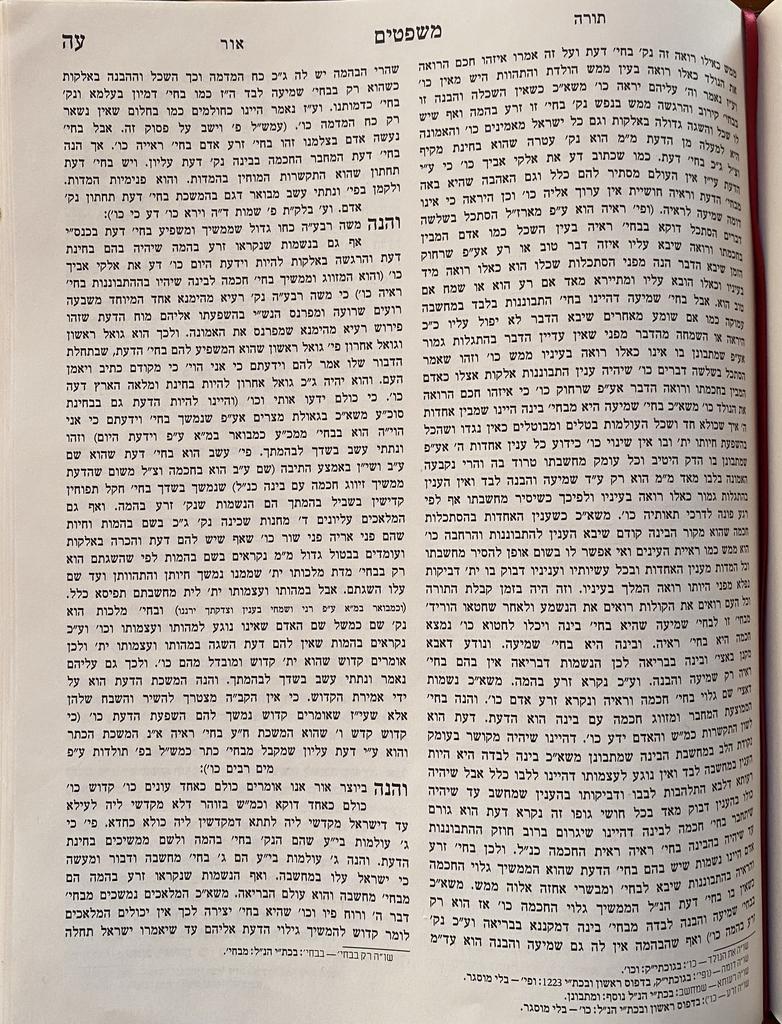
Torah Or page עה Second column beginning with והנה משה רבע״ה
By Rabbi Shneur Zalman of Liadi
Translation and Commentary by Rabbi Gedalia Potash and William Schecter, MD
Thursday January 27, 2022
This draft has neither been edited nor approved by Rabbi Potash
The great strength of Moses draws down the attribute of Da’at (knowledge) to the Knesset Israel (the community of Israel) but also to the souls which are called the animal seed which will have within them Da’at and an emotional feeling fo Divinity so that “they will know this day etc”(Deuteronomy 4:39). Know the the G-d of your fathers etc ( I Chronicles 28:9) which is the union which draws down the attribute of Wisdom to Understanding with the attribute of vision, etc) because Moses was called the faithful shepherd. He is the special one among the seven shepherds who shepherded and sustained the souls of Israel and it is through Moses that the intellect of Da’at flows to the Children of Israel and this is the meaning of the term “faithful shepherd” which provides sustenance to faith.
Comment: Da’at: Rabbi Potash explained that we the Elter Rebbe is not talking about knowledge here as we understand it. It is a supernal knowledge which combines intellect and emotion. The emotional yearning we have to be united with G-d with a true intellectual and emotional connection. This “drawing down” of Da’at, the intellectual/emotional “oneness” with G-d occurs through Moses, “the faithful shepherd.
The Seven Shepherds are seven historical leaders which both guide and provide spiritual sustenance to the of the Jewish People. They are Abraham, Isaac, Jacob, Joseph, Moses, Aaron and David. Traditionally they are the guests, ushpizin, which we invite into the Sukkah during the Holiday of Sukkot. Abraham sustains the people with Love, Isaac with Awe, and Moses with Da’at—the supernal Knowledge of which we have been speaking.
And for this reason Moses is the first redeemer and the last redeemer meaning the first redeemer is the one through whom flows the attribute of Da’at which G-d spoke first to will believe them saying “and you shall know that I am the L-rd “ because prior it was written “and the People were convinced” ( Exodus 4:31 ). And he will also be the final redeemer being the attribute “For the land shall be filled with Da’at (devotion) to the LORD “Because all will know Me etc.” (meaning Da’at will be also the attribute of encircling all the worlds which is not the case with the redemption from Egypt although it is drawn down with the attribute “and you shall know that I am the L-rd” it is the attribute of “filling all the worlds” as explained elsewhere).
Comment: Moses cultivates and instills within the Jewish People and emotional wisdom (knowledge) of G-d, a deep personal connection. Moses also is a redeemer. Rabbi Potash explained that there are two types of redemption: 1. The Exodus from Egypt: from slavery to freedom, from spiritual degradation to the receipt of the Torah at Mount Sinai. 2. The Messianic Age: According to our Theology, at the end of days we will all have an intimate knowledge and connection with G-d and be freed of any material distractions. Even though there was a surge of redemption which occurred during the Exodus, this surge will be as nothing compared to the redemption that will occur during the Messianic Age.
And this is the meaning of “ I shall give grass in your field for your domestic animals” (Deuteronomy 11:15)
Comment: This sentence is part of the Sh’ma Prayer. It is an analogy for drawing down a spiritual nourishment drawn through the nourishing process of the spiritual fields
Meaning that grass is the attribute of Da’at drawn down to your field the attribute of a field of holy apples for your domestic animals which are the Grass is the attribute of Da’at which is written with an ע ב with a ש in the middle of the word (עשב=grass) which draws in the field the attribute of a field of holy apples for your domestic animals which are the souls that are called the animal seed.
Comment: Comment: In this metaphor, the domestic animals are the souls of Israel and the angelsand the grass is the Da’at – the combination of wisdom and true emotional understanding and connection. It is through Moses, the Faithful Shepherd, that Israel receives Da’at.
(The name עשב is wisdom and we must understand that because the Da’at draws down the combination of wisdom and understanding as explained above) And also the supernal angels, four camps of Shekinah, are also called by the name of domestic and wild animals as they are the face of a lion and the face of an ox etc.
Comment: This confusing statement is a reference Ezekiel’s Vision (Ezekiel 1:6). It is explained in the commentary of Pirkei DeRabbi Eliezer 4:3. I will list the entire passage for you as it explains the strange imagery:
Four classes of ministering angels minister and utter praise before the Holy One, blessed be He: the first camp (led by) Michael on His right, the second camp (led by) Gabriel on His left, the third camp || (led by) Uriel before Him, and the fourth camp (led by) Raphael behind Him; and the Shekhinah of the Holy One, blessed be He, is in the centre. He is sitting on a throne high and exalted. His throne is high and suspended above in the air. The appearance of His Glory is like the colour of amber. And the adornment of a crown is on His head, and the Ineffable Name is upon His forehead. One half (of His glory) is fire the other half is hail, at His right hand is life and at His left is death. He has a sceptre of fire in His hand and a veil is spread before Him, and His eyes run to and fro throughout the whole earth, and the seven angels, which were created first, minister before Him within the veil, and this (veil) is called Pargod. His footstool is like fire and hail. Fire is flashing continually around His throne, righteousness and judgment are the foundation of His throne. And the likeness of His throne is like a sapphire throne with four legs, and the four holy Chajjôth are fixed to each leg, each one has four faces and each one has four wings, as it is said, "And every one had four faces and four wings" (Ezek. 1:6), and these (Chajjôth) are the Cherubim.
Although angels have Da’at and familiarity with the Divine and stand with great nullification, in any case they are called by the name of domesticated animal because their comprehension is only at the level of Malchut from which is drawn their vitality and formation. The comprehension of the angels ascended to this level.
Comment: Although the angels are refined beings, they lack Da'at and originate at a lower spiritual level (Yetzirah) than the soul of man (Briah).
But G-d’s true essence is unable to be grasped by the angels’ thought at all. The attribute of Malchut is called “name”. Why? Just like the name of man does not really touch (describe, explain) man’s essence, the name Malchut is incapable of describing the essence of Malchut. That being the case, the angels are called domestic animals because they lack Da’at-combined intellectual and emotional comprehension of His essence and therefore they say Kadosh (Holy), describing G-d, because He is Holy and separate from them.
Comment: The above sentence refers to the famous declaration of the angels which appears in Isaiah (6:3) and is incorporated into the second of two blessings preceding recitation of the Sh’ma in the morning service. “Holy, Holy, Holy is the L-rd of Hosts. The whole world is full of His Glory
Meaning that G-d is Holy and Separated from the angels etc. For this reason, it is also said about them: “and I shall give grass in your fields for your domestic animals”. And here the drawing down of Da’at occurs through the utterance of Holy. Because G-d does not require their song or praise, rather, by the angels saying “Holy”, they draw down to themselves Da’at (Because “Holy, Holy etc” is the drawing down of the supernal wisdom with the attribute of vision of supernal knowledge or the drawing down of Keter (the crown) and through the supernal Da’at that it receives the Keter….)
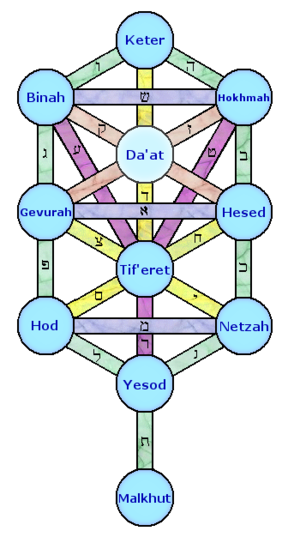
Comment: What is Keter? There are 10 Sephirot in Kabbalistic Cosmology. The word sephirot is defined as emanations. They are the 10 attributes or emanations through which the Infinite (Ein Sof- אין סוף) is revealed. The Ein Sof creates the physical realms —the world of Asiyah worlds as well as the higher metaphysical worlds of Yetzirah, Briah and Atzilut through the chain of Histalshalut-the flowing down of the Infinite Light which undergoes Tsimtsum (Contraction) at the various stages of descent. Keter is the topmost of the Sephirot of the Tree of Life in Kabbalah. Hence, the name Keter-Crown. Keter is called the “most hidden of all things” in the Zohar and is incomprehensible to man but has been describe as absolute compassion. This Keter, or crown, connects directly with the lowest of the Sephirot, Malchut (monarchy) much like a crown sits upon the head of a king. Keter represents the primal stirrings of Divine Intent and Desire to bring forth creations. Keter is the most intimate connection with the power of Ratzon—G-dly Desire. As the Elter Rebbe will soon explain, Keter and Da’at are part of the same phenomenon. Keter is the internal component and Da’at the external component. When they are listed together with the other Sep;hirot, the toral is 11 but we say there are 10 Sephirot because Keter and Da’at are considered one entity.
If you consult the "Tree of Life" cartoon that I have inserted prior to the Hebrew text in this sheet, you can visually see the Sephirot. If you count them, you will notice that there are eleven Sephirot. Without explaining the significance (as far as it is possible to understand) of all the Sephirot), suffice it to say that we still count only 10 ASephirot because Keter and Da'at are considered one entity as we have said.
And in the prayer Yotzer Or (this prayer precedes the recitation of the Sh’ma) we say “All with respond as one etc, Kadosh, etc”, all are as one as it is written in the Zohar–“sanctity cannot take place from above until the Israel sanctifies itself below. Kolam keechad – all are unified, Heaven and Earth.” Meaning that the three worlds of Briah, Yetzirah and Asiyah are called the attribute of domestic animal and Da’at is drawn there. The three worlds of Briah, Yetzirah and Asiyah are the three attributes of thought, speech and action because Israel ascended in thought. But the souls that are called seed of domestic animals are the attribute of thought from the world of Briah. This is not the case for the angels which are drawn from the attribute of the Word of G-d and the Spirit (breath) of His mouth etc, which is the attribute of Yetzirah and for this reason the angels are unable to say Kadosh and draw the revelation of Da’at to themselves until Israel first says “Kadosh” because the drawing down one must understand the order in which the Da’at is drawn in the thought and from thought to speech as it is impossible to speak unless one first thinks first about the combination of words that one wants to say. Indeed, also it is impossible for Israel to say “Kadosh” until the angels say “Kadosh” because the root of the souls of Israel has the attribute of thought which is above the world of Asiyah (Briah is the world of Thought of the Souls of Israel whereas Asiyah is the world of Speech of the angels). But from the side of investment in the bodies (the G-dly Souls of the Jewish People are invested in their corporeal sheaths in the world of Asiyah—our netherworld), they are the attribute of Asiyah, far below the angels in the world of Yetzirah (the world of the angels). They both need to receive one from the other. And therefore “sanctity cannot take place from above until the Israel sanctifies itself below. Kolam keechad – all are unified, Heaven and Earth” all respond as one (and this is “Keter that the angels will give to You etc.
Comment: The Elter Rebbe is saying that the souls of Israel are located in the world of Briah which is spiritually above the world of Yetzirah, the location of the angels. Paradoxically, humans inhabit the netherworld, the world of Asiyah, which is spiritually below the world of Yetzirah, the location of the angels. Returning to “Kedushah” the recitation of the “Holy, Holy, Holy, etc.”, the Elter Rebbe says the angels cannot recite the passage before the Jewish People and vice versa because of their varying levels of spirituality. Both the Jewish People and the angels need to sanctify themselves together.
And Your people Israel etc. together etc.” The meaning of “Keter will give to you” is that the Da’at will be drawn down by Keter (remember that Keter and Da’at are basically one entity) which will draw down the souls of Israel through which will also be drawn the revelation of the Keter to the Zayir Panim because the Da’at is the externality of the Keter.
Comment: Anpin Zayir is the name of the face created from inclusion of the attributes of the World of Atzilut. Zayir Anpin and Malchut of Atzilut are also called by the Aramaic Name “kudshal brich hu shekinahtya. The unity between them is the yichuda Tahtah (the lower unity) the mitzvot that we perform are for the sake of the unification of zayir anpin and malchut diatzilut.
Therefore, when the Keter is counted the Da’at is not counted etc. and we must understand that the Da’at is what must begin the drawing down from the Keter and when we must understand that to draw down we must first draw up from below as it is written in the intention of “Baruch Sheamar”
Comment: The Baruch Sheamar prayer opens the Psukei DiZimra section of the morning service. These Psalms and poems are designed to open man’s heart to the love of G-d in preparation for the recitation of the Sh’ma. In other words, it helps man to reach up toward the Infinite which is simultaneously being drawn down to us. If you are not completely familiar with the Baruch Sheamar poem, I am listing the translation here for your convenience.
Blessed is He Who spoke, and the world came into being, blessed is He; blessed is He Who maintains the creation; blessed is He Who says and does;1God's saying and doing are synonymous and simultaneous as it is said, “By the word of God the heavens were made” (Psalms 33:6).—Etz Yosef blessed is He Who decrees and fulfills;2“Says and does” refers to those things that are not lasting and must be renewed whereas, “He decrees and fulfills,” refers to those things that have קיום, and last forever.—Tzelosa d'Avrohom blessed is He Who has compassion on the earth; blessed is He Who has compassion on the creatures;3Not only is God's compassionate providence concerned with the earth and enduring things, but His compassion and providence extend even to those creatures which are destined to perish.—Avudraham blessed is He Who rewards well those who fear Him, blessed is He Who lives forever and exists eternally; blessed is He Who redeems and saves4God redeems those who are in captivity and saves others from being taken into captivity. blessed is His Name. Blessed are You, Adonoy, our God, King of the Universe, the Almighty, the merciful Father, Who is verbally extolled by His people, praised and glorified by the tongue of His pious ones, and His servants, and through the songs of David Your servant. We will extoll You, Adonoy our God, with praises and psalms; we will exalt, praise, and glorify You; we will mention Your Name, and proclaim You—our King, our God. Unique One, Life of the worlds, King, praised and glorified forever is His great Name. Blessed are You, Adonoy, King, Who is extolled with praises.
The Da’at is drawn through Moses , he is the one who draws down the Da’at from the head of all the levels to the end of all the levels so that it will pass and be drawn with all the attributes from thought, speech and action.
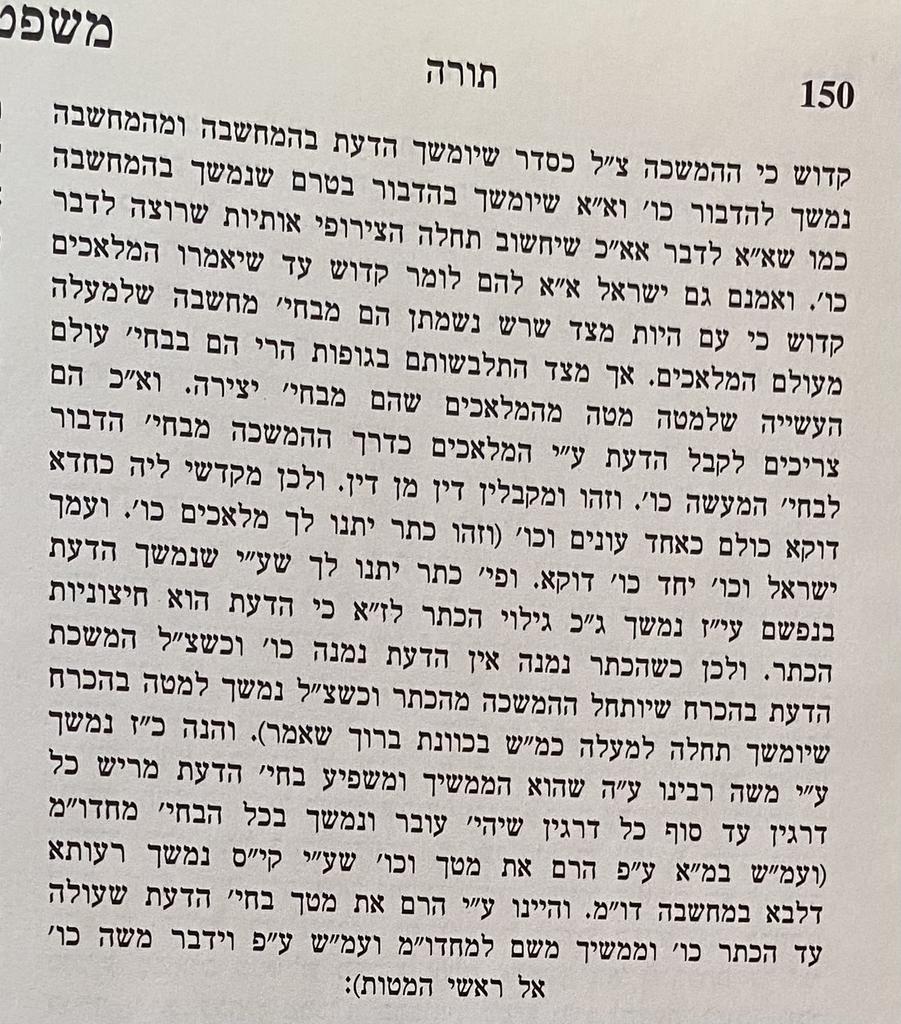
We ended our reading on page 150 at the end of the first paragraph of the first column