Parashat Shemini 2
from Likutei Torah by Rabbi Shneur Zalman of Liadi
Translation and Commentary by Rabbi Gedalia Potash and William Schecter, MD
This draft has been neither edited nor approved by Rabbi Potash
April 9, 2021
The sixth Aliyah of Parashat Shemini discusses Kosher foods. The Elter Rebbe begins his Kabbalistic discussion of Shemini by discussing the conflict between the Wild Ox and the Whale which Shect (ritually slaughter) each other. Let’s see what happens.
“And Leviathan that You formed to sport with” (Psalm 104:26).”. In the Midrash Rabah 8:13 there is a comparison of the competition between Beasts and the Leviathan with Tsadikim in the future to come. The beasts gore the Leviathan with its horns tearing its flesh and the Leviathan (whale) shatters and punctures the beasts with its fins. The Elter Rebbe asks “How could we say that the Leviathan will slaughter the beasts with its fins and the beasts will tear the Leviathan with its horns. Haven’t we learned (from the laws of Kashrut) that anyone can schect (slaughter in a Kosher manner) using a sharp Kosher knife but not a sickle? Meaning that the shecting of one beast by another is not kosher. The Elter Rebbe responds to his question by saying the laws of the Torah will be renewed in the Messianic Age permitting this type of shecting of the beasts by the Leviathan.
Rabbi Potash commented on the concept of Shechita (slaughtering). At first glance, (especially to us Northern California vegetarians!), the process seems brutal and even primitive. But, says Rabbi Potash, in Judaism there is no valid act that does advance the purpose for which it was intended. So, the concept of Shechita (שחיטה—slaughtering) is not killing but Meshichah (משיכה—drawing down of Divine Energy). Note that although the words Shechita and Meshicah sound similar, they have different roots so do not share a common definition. So, the process of Shechitah elevates the animal to a higher spiritual level (probably of little consolation to the animal as its throat is being slit!).
The beast referred to is the Wild Ox. How do we understand this competition between the Leviathan and the Wild Ox? The Elter Rebbe tells us that there are two types of Tsadiks. The type I Tsadik serves G-d in secret with spirituality meaning that the intention of his heart is the unification of the supernal unity with the attribute of ascension. What is the Elter Rebbe getting at with this statement? He gives an example of a Type I Tzadik Rabbi Shimon bar Yochai who lived in a cave for 13 years in the Galilean village of Peki’in hiding from the Romans. He is said to have written the Zohar, the prime text of Kabbalah, during his 13-year sojourn in the cave. Rabbi Shimon bar Yochai certainly was unable to fulfill some of the positive commandments for he was nourished only by carob seeds and as such did not fulfill the commandment to eat Matzah during Pesach, to sanctify the wine, have an etrog and a succah etc. and many of the Rabbis of the Talmud similarly were Type I Tsadikim from a spiritual point of view.
The Type II Tsadik are those Tsadikim who physically serve G-d openly for all to see by fulfilling the positive commandments, rejoicing in the Holidays which also draws down Divine Energy during the Holy Festivals and the joy is the revelation of the Divine Energy (a synonym for G-d). And this drawing down occurs through the Mitzvot. During the time of the Holy Temple, there was no joy without the meat sacrifices. The peace offerings and the offerings for the Festivals were brought to the Holy Temple every Holiday but now there is no Joy except with the wine as will be explained below. The principle of the drawing down (of Divine Energy) during Pesach through Matzah, during Shavuot with the Giving of the Torah, on Succot by dwelling in the Sukkah, the Lulav and the Four Species for without this, it is impossible to draw down (the Divine Energy). But in truth, it is not possible to reach His Divinity through Physical Service (the performance of positive commandments) alone, but rather through the Type I Tsadikim referred to above.
Rabbi Potash commented that the Types I and II Tsadikim complement and support each other in drawing down the Divine Energy and elevating the Energy in our World to rise to meet It.
These Type I Tsadikim are called “the Fish of the Sea” because just as the sea covers the fish, these Type I Tsadikim belong to the hidden world and in each generation, there are hidden Tsadikim and they connect G-d’s worlds. The issue of connection is the whole point of the Leviathan (in Hebrew לויתן) which has the same root as Levi (לוי in Hebrew), the third son of Leah, the unpreferred wife of Jacob. For Leah, upon the birth of her third son, named him Levi (connection, accompaniment) for she hoped that now (after the birth of Levi) her husband would be more connected to her.
But because this world is material, we also require Tsadikim Type II that serve G-d by the performance of physical positive commandments……. And everything that is on dry land there is also in the sea and we need both. (that is Tsadikim Type I AND II). And the path of Type I Tsadiim who are called the fish of the sea is wonderous and very elevated like, for example, the fish swimming in the sea and then fly (jump) out of the sea to a great height, a height much greater than that achieved by the Type II Tsadikim who experience the material joy of the meat (of the Holiday offering in the Temple). All this is on a lower spiritual level. If so, their path (Type I Tsadikim) is like the fish swimming in the sea from one end of the world to the other, such is their spiritual path, that with one jump (the Elter Rebbe uses the word flight) they reach great spiritual heights. BUT they do so without the burning excitement, the “boiling of the blood” (referring to human passions -- perhaps the Animal Soul is transformed now to a higher spiritual direction by the suppression of animal desire and transformation to spiritual planes in the Type I Tsadik) experienced by Type II Tsadikim. And the material joy of the meat and the wine have the attribute of flames of a fire (an analogy to the flames consuming the sacrifice on the alter) as opposed to the cold blooded and relaxed spiritual service to G-d of the Type I Tsadikim who with one flight reach the highest (spiritual levels) referred to above. And it is impossible to explain this phenomenon and describe it. Therefore, the Rashbi (Rabbi Shimon Bar Yochai), during his stay in the cave, did not fulfill some of the 248 positive Mitzvot referred to above but rather performed them spiritually on high with the attribute of joy from the meat (sacrifices). And this is the issue of the fins of the Leviathan with which it swims from one end of the world to the other.
Rabbi Potash commented: The movement of fish in sea is much faster and smoother than movement of beasts on dry land. The very fin that functions as the force which moves the Leviathan through the sea is that which the Leviathan endows to the ox which is much more tedious in its motion. The slaying of the Wild Ox by the Leviathan elevates it spiritually.
Therefore, the entire world stands upon the Leviathan that encircles the whole world as we know from the words of the Rabbis of the Talmud. And in the future, the Leviathan will make war upon the Wild Ox and will shect (slaughter) the Ox with its fins. And here is the service of the Type II Tsadik, called the Wild Ox, wild and pure because the service of the Type II Tsadik is in material action such as rejoicing in the Holidays and the statement that there is no joy without the meat (sacrifice) does not really have the significance of its simple meaning, that the meat of the ox would be eaten until the belly is full, G-d forbid, and then he would rejoice in it, but rather it is the elevation of the peace offerings of happiness from the physical meat (that is by burning the meat on the alter, the physicality of the meat is transformed into spirituality pleasing to G-d).
In the time of the Holy Temple the sweet smell of the burning sacrifice would be pleasing to G-d and through this would come the happiness of the meat offering of the Holiday as it is written “Rejoice in You” (Psalms 40:17, 85:7, 70:5) …in You in particular but it is the language of request because our Holy Temple was destroyed. And this is called the Wild Ox from the expression Bar Levav (בר לבב—meaning ethical, honest, loyal). The Wild Ox represents pure wild meat sacrifice that is to say, joy to G-d born from the flames of the fire and the burning excitement. But it is but a small thing (the Type II Tsadik) compared to the wonderous path of the Type I Tsadik called the Leviathan which comes from a material thing with boundaries but their path with one flight, without excitement or emotion, reaches great heights greater than infinity and therefore the Leviathan (the Type I Tsadik) shects the Wild Ox. What does this mean? The Leviathan will elevate the Wild Ox through its flight with its fins far above what is possible for the Wild Ox to achieve with its own power. But the Wild Ox also elevates the Leviathan through its material service to God—as explained in the Torah—"you shall rejoice in you Holiday” and there is no joy without the meat offering and the win libation on the mizbeach (alter) and in this way the Wild Ox elevates the Leviathan as well.
Rabbi Potash commented that initially, we might have thought that the Wild Ox—the Type II Tsadik—was negative. But no, the Type II Tsadik is expressing is joy in a wild way in a positive context. So that both the Leviathan and the Wild Ox, that is the Type I and Type II Tsadikim, complement each other. Both are necessary.
Our discussion ended at this point.
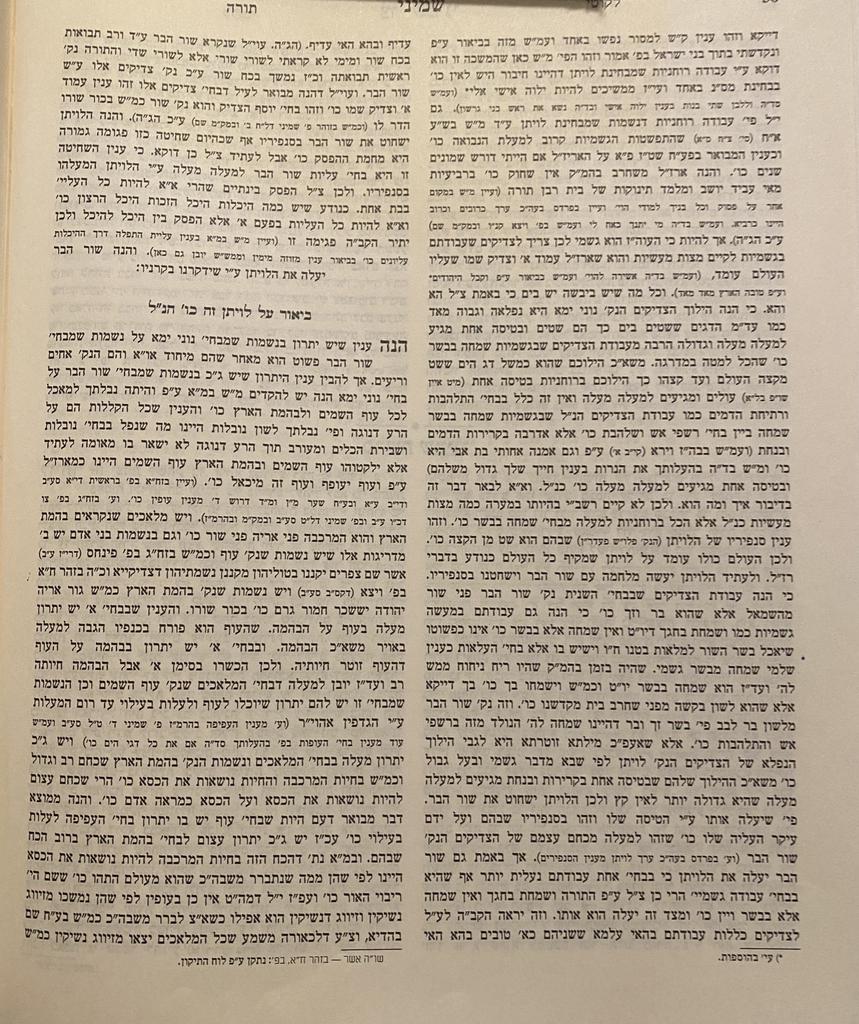
Parashat Shmini
Beginning next to the last line on page 36 column 1
This is a continuation of the translation from last year
March 28, 2022
In the world to come G-d will show the entirety of the service of the Righteous. In some instances the service of Tsadik type 1 is preferable and in other instances the service of Tsadik type 2 is preferable. The Leviathan will slaughter the wild ox with its fins even though such a shecitah today is invalid (notg Kosher) because of the fact that a sharp blade without any defects was not used with one swipe of the blade. But in the world to come this law will not be in effect. This slaughter (Shechitah) elevates the wild ox by way of the fins of the Leviathan which flies out of the water. Therefore, there must be separations (or stages) in the cutting since it is impossible for a complete elevation to occur at once.
As is known there are several Holy Temples, the Temple of merit, the Temple of G-d’s Will, etc and therefore it is impossible for all the elevations to occur at once but there must be a stop between each Temple (in each spiritual level) and therefore G-d permits this type of Shechitah (which would otherwise be forbidden). Conversely, the Wild Ox elevates the Leviathan by stabbing it with its horns.
Comment: The various Temples alluded to above are discussed in the Zohar. The Elter Rebbe is comparing the Leviathan who can swim from one end of the world to the other with a flick of its tail, underneath the water—hidden-- to the Type 1 Tsadik who is on the highest spiritual plane. He is comparing the Wild Ox to the Type 2 Tsadik who is on a lower spiritual plane dealing the physicality of the world. Both Tsadidim are necessary and each one elevates the other. The Elter Rebbe is using the Midrashic Parable of the Leviathan (the purely spiritual) and the Wild Ox (the physical) to make this point. The spiritual and the physical are in constant conflict but elevate each other
.
The explanation of this Leviathan referred to above
There is an advantage to the souls with the attribute of fish in the sea compared to those with the attribute of the wild ox. It is simply that since they both are each derived from the Divine Unity, they are called brothers and friends. The souls with the attribute of the wild ox in turn have an advantage over the fish of the sea. To understand this advantage we can refer to the following passages
“וְהָיְתָ֤ה נִבְלָֽתְךָ֙ לְמַֽאֲכָ֔ל לְכׇל־ע֥וֹף הַשָּׁמַ֖יִם וּלְבֶהֱמַ֣ת הָאָ֑רֶץ וְאֵ֖ין מַחֲרִֽיד׃
Your carcasses shall become food for all the birds of the sky and all the beasts of the earth, with none to frighten them off.” (Deuteronomy 28:27)
The point is that all the curses are due to the evil in the Klipat Nogah and the interpretation of “your carcass (נִבְלָֽתְךָ֙ )” is baseness or villainy (נבלות)
Comment: The Elter Rebbe is using the semitic root נבל to equate the word for carcass to that for baseness since they both have the same root. The Klipat Nogah of course refers to the fourth layer of materialism surrounding the soul which contains elements of both good and evil according to Kabbalah.
What does this mean? Nothing will remain of the baseness and broken vessels (Sefirot) which then mixed with the Klipat Nogah in the future. Rather they will be collected by the birds of the sky and the beasts of the earth. The Talmudic Sages said that the expression “birds of the sky” refer to the angel Michael. There are other angels that are called the beasts of the earth. The chariot (מרכבה ) has the face of the lion and the ox, etc. The souls of man have two levels, those whose souls are called birds as discussed in the Zohar in Parashat Pinchas where birds nest in their shadows and the souls of the Tsadikim will be housed in the nests of birds. and there are souls which are called the beasts of the earth as it is written “Judah is a lion’s whelp” (Genesis 49:9), “Issachar is a strong-boned ass” (Genesis 49:14), and “Like a firstling bull in his majesty” (Deuteronomy 33:17) referring to Joseph.
Comment: The Chariot refers to the vision of Ezekiel which we have discussed previously. You can review it by reading the beginning of the book of Ezekiel in the Tanach.
We ended our discussion here on page 36 coumn 2 paragraph 2 with the line יהודה
יששכר חמור גרם