Parashat Korach
from Likutei Torah by Rabbi Shneur Zalman of Liadi
Friday June 11, 2021
Translation and Commentary by Rabbi Gedalia Potash and William Schecter, MD
This draft has been neither edited nor approved by Rabbi Potash
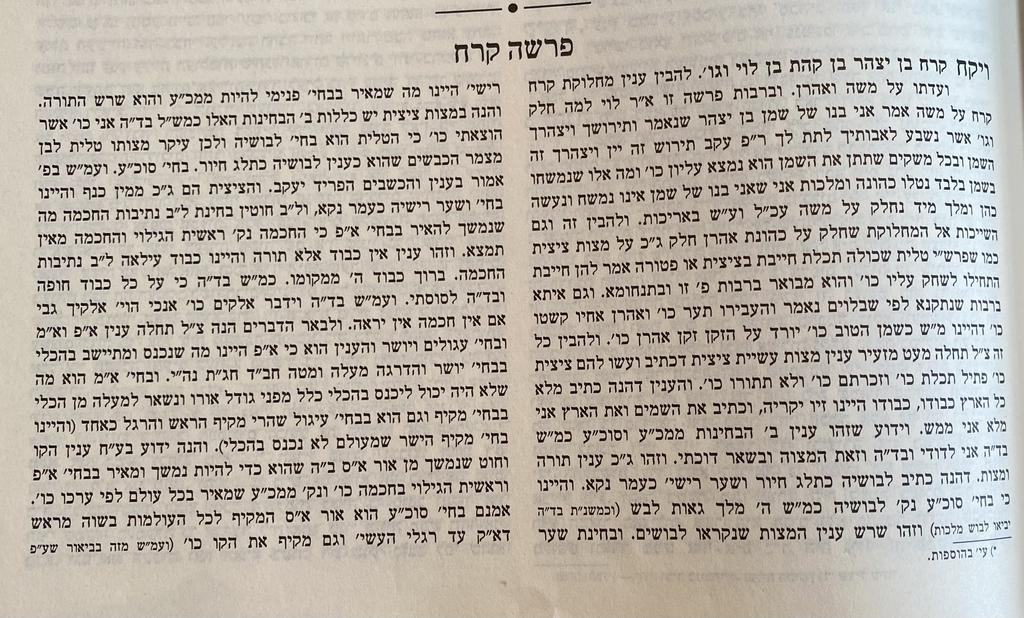
The Elter Rebbe begins his discussion by quoting the first line of our Parasha: “Korach, the son of Yitzhar, the son of Kahat, the son of Levi….” and then seeks to understand the conflict between Korach, his followers and Moses and Aaron. There were in fact 3 reasons according to our sources. To explain the first reason, the Elter quotes Rabbi Levi who asks “Why did Korach dispute with Moses?” To understand Rabbi Levi’s answer, we must first translate the name of Korach’s father, Yitzhar (יצהר). Yitzhar is the name given to the first pressing of olive oil, which is the highest quality oil. Now we are ready to study Rabbi’s Levi’s response to his own question. Rabbi Levi says that Korach said “I am the son of Oil, the son of the first pressing (Yitzhar) (the implication being that he, Korach, is a high-quality person who deserves a leadership role), as it is written “your first pressing of grapes (תרושך) and your first pressing of oil (יצהרך)” (Deuteronomy 7:13) which was sworn to your fathers to give to You. And of all the libations, Oil has the supreme position for oil is used to anoint both Priests and Kings. How is it that I, the son of oil (Yitzhar) am not anointed Priest or King? So, Korach felt that he should be both the leader of the people and the High Priest.
To understand this fully, says the Elter Rebbe, we must understand the disagreement with Moses over the High Priesthood given to Aaron and his disagreement with Aaron concerning the commandment of the Tzitzit (this commandment was described in the last portion of last week’s Parasha- Numbers 15:38-39).
Comment: The fringes (tzitzit) on the garment (tallit) are required to be worn whenever a four cornered garment is worn. These tzitzits remind one of the 613 commandments. Each corner of the garment has 8 threads one of which is dyed marine blue (tachelet) with a dye manufactured from Chalazion (a shell fish). The numerical value of the word tzitzit (ציצית) is 600. Each corner has 8 threads and 5 knots on the 8 threads. 8+5=13. So, 600 + 13 = 613 = to the 613 commandments in the Torah.
Rashi said that Aaron argued that even if the Tallit is completely Tachelet (marine blue) it still requires the Tzitzits to be attached whereas Korach disagreed with this view. Moses sided with Aaron and said that the Tallit required the tzitzits. Korach and his 250 comrades began to laugh at them. This is explained in the Midrash Tanchumah.
Korach was also jealous of the fact that all members of the Tribe of Levi were required to shave their entire bodies with the exception of Aaron and the members of his family. Meaning, as it is written, “It is like fine oil on the head running down onto the beard, the beard of Aaron, that comes down over the collar of his robe” (Psalm 133:2) To understand all of this we must first understand a little about the making of the tzitzit. “Speak to the Israelite people and instruct them to make for themselves fringes on the corners of their garments throughout the ages; let them attach a cord of blue to the fringe at each corner”. (Numbers 15:38) “That shall be your fringe; look at it and recall all the commandments of the LORD and observe them, so that you do not follow your heart and eyes in your lustful urge”. (Numbers 15:39)
Comment: This passage from the Torah is a part of the last paragraph of the Sh’ma prayer recited twice daily by observant Jews.
And the issue is that here it is written “the whole earth is filled with His Glory” (Isaiah 6:3), Glory meaning precious light. As it is written “If a man enters a hiding place, Do I not see him? —says the LORD. For I fill both heaven and earth —declares the LORD. (Jeremiah 23:24) And it is known that this is the issue of the two attributes: 1. Filling all the worlds, ממלא כל העולמים abbreviated ממכ"ע 2. Surrounding all the worlds, סובב כל העולמים, abbreviated סוכ"ע. The Elter Rebbe now quotes several sources to illustrate these two concepts although I have trouble seeing the connection. As it is written “I am my beloved’s and my beloved is mine; He browses among the lilies.” (Song of Songs 6:3), “And this is the Instruction—the laws and the rules—that the LORD your God has commanded [me] to impart to you, to be observed in the land that you are about to cross into and occupy (Deuteronomy 6:1)”, “and in the remnant of my suppression” (I couldn’t find the source for this quotation).
Comment: These two expressions: Filling all the worlds- ממכ"ע and Surrounding all the worlds - סוכ"ע – are key Chassidic concepts that refer back to the famous phrase from Isaiah “the whole earth is filled with His Glory” where Glory is defined as precious light. The Elter Rebbe will now explain these concepts in greater detail.
The Elter Rebbe now draws a relationship between “Filling all the worlds” and “surrounding all the worlds” and the Torah and Mitzvot. How so? It is written “His garments are like white snow and the hair of His head is like pure wool” (Daniel 7:9) meaning that the attribute of “surrounding all the worlds is called “His garments” as it is written “The LORD is king, He is robed in grandeur” (Psalms 93:1). This is the root of the issue of Mitzvot which are called garments.
Comment: The Mitzvot are called the garments (of the Lord as referred to in the passage from the book of Daniel) which are compared to the Divine Light surrounding all the worlds from within.
The attribute of “the hair of His head” provides internal illumination filling all the worlds. This is the root of the Torah. The Commandment of Tzitzit includes both of these attributes as will be demonstrated in the passage “I am the Lord Thy G-d who took you out of the Land of Egypt to be your G-d, I am the Lord thy G-d” (Numbers 15:41—the last line of the last paragraph of the Shm’a which discusses the commandment of Tzitzits). The Elter Rebbe used the previous quotation because the Tallit has the attribute of “His garment” and therefore the principle of the Tallit Mitzvah is that it is made of white lamb’s wool which is like “His garment like white snow”—the attribute of “surrounding all the worlds”. Study what is written about the adult sheep that Jacob separated. (Genesis 30:32-36).
Comment: The Elter Rebbe is of course referring to the confusing story about Jacob separating every speckled and spotted sheep and every black lamb and the spotted and speckled goats from Laban’s flock which were to be his wages as he builds his own flock in preparation for leaving Laban with Leah, Rachel, the two concubines and their children. The Elter Rebbe then refers us to his commentary on Parashat Emor which discusses this story. I went back and looked up his commentary. The Torah uses two words for sheep: כבש (keves) and כשב (kesev). When we were studying this passage together on Friday morning, I asked Rabbi Potash about the difference between these two words because in modern Hebrew, I have always heard sheep referred to as “Kvasim” and have never heard the word kesev used. The Rabbi looked this up on Google and learned that in Biblical Hebrew, keves refers to a lamb and kesev refers to an adult sheep older than two years. However, when I looked up the Elter Rebbe’s commentary on this question in Parashat Emor in his book Likutei Torah, the one we are studying, I found a complex Kabbalistic interpretation of why the letter Shin precedes the letter Beyt in Kesev and vice versa in Kesev. Unfortunately, I could not follow the complex argument without Rabbi Potash’s guidance and perhaps I will study the passage with him in the future and report back to you.
Rabbi Potash commented: Keves also means to put down or suppress. The Sin offering (sacrifice) is a keves (a lamb too immature to reproduce) m so it puts an end to the sin.
The Tzitzits are also a kind of wing meaning it has the attribute of “the hair of His head like pure wool”, and the 32 threads (of the tzitzits) have the attribute of the 32 paths of wisdom which are drawn down to illuminate the attribute of the internal light (within the Soul) because Wisdom is called the first of the revelation and the wisdom will be found from nothing.
Rabbi Potash commented: Although the attribute of Wisdom (Chochma) appears to us to be derived from nothing, it is because we are unable to perceive the Infinite Divinity which existed prior to the creation of all the worlds and will exist after their disappearance. Chochma is the beginning of consciousness. It feels like it comes from nothing but it comes from a place we can’t understand therefore it seems like it comes from nothing. Even though Chochma is the first step towards understanding, we have to realize that there is something above it that may not be understandable and everything comes from that level. Why should everything be logical. Logic is a construct. There is a break between that which is higher than Chochma and Chochma. The concept of אין - nothing - is beyond human comprehension.
Even Torah functions in this context of Chochma. Torah descends from the illogical to Chochma. The hair grows from the vitality of the body. At the same time, you can’t compare the level of the vitality of the hair to the complexity and the sophistication of the rest of the body. Similarly, the Torah is like the hair and the body is like G-d. The Torah is so vast but can’t be compared to G-d.
This is the issue: there is no Glory except the Torah meaning the Supernal Glory of the 32 paths of Wisdom. “Blessed is the Glory of the LORD, in His place” (Ezekiel 3:12) as it is written in the passage: “Indeed, over all the glory shall hang a canopy, which shall serve as a pavilion for shade from heat by day and as a shelter for protection against drenching rain.” (Isaiah 4:5-6) and as it is written “I have likened you, my darling, to a mare in Pharaoh’s chariots: Your cheeks are comely with plaited wreaths, Your neck with strings of jewels.” (Song of Songs 1:9) And study where it is written “God spoke all these words, saying: I the LORD am your God who brought you out of the land of Egypt, the house of bondage: (Exodus 20:2) regarding the well-known expression “If there is no Wisdom, there is no Awe (of G-d)” (Pirkei Avot 3:17).
Comment: So, what is the Elter Rebbe trying to say with all these quotations? He goes on to explain.
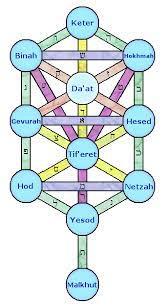
To explain these things, we must first understand the issue of “Internal Light” (Or Pnimi) and “Surrounding Light” (Or Makif) and “the Circles” and “the Straight”. The point is that the “Internal Light” is that which enters and dwells in my Temple (or my Chamber), that is—within me with the attribute of a straight line from above to below, meaning a straight descent from the attributes of Chochma (Wisdom), Binah (Understanding), Da’at (Knowledge) {abbreviated חב״ד}; Chesed (Loving Kindness), Gvurah (Discipline), Tiferet (Beauty) {abbreviated חג״ת}; and Netzach (Eternity), Hod (Splendor) and Yesod (Foundation) {abbreviated נה״י}.
Comment: These attributes are nine of the ten Kabbalistic Sephirot which have their reflections in the Divine Soul, hewn from the Divine Source which descends in a straight line to be enclothed in the material body in our world.
The attribute of the “Encircling Light” is that which was unable to enter into “My Chamber” because of the immensity of its Light (Energy) and remains above “My Chamber” surrounding it with the attribute of a circle, encircling both the head and the foot as one entity. And here it is known in the Atz Haim (a Book of Kabbalah written in Safed in the 16th century) that the line and thread drawn down from the Divine Eternal Light exists in order to be brought down and illuminate (the Soul) as the Internal Light and the beginning of revelation occurs in Chochma. This is called Filling all the Worlds that illuminates the whole world according to its value”.
Comment: There are two Kabbalistic concepts to which the Elter Rebbe refers in the paragraph above which deserve comment. The first is “the line or thread” which exists between the Eternal Divine Light, the Source of the G-dly Soul of each person, and the G-dly Soul itself. According to this line of thought, there is a spark of Divinity within each person which had a continuous direct connection (a thread) with its Source in the Infinite Eternal Divine Light. In other words, we all have a continuous direct connection to G-d.
The second concept is that revelation (of the G-dly Soul) begins in Chochma. Why does it begin in Chochma (Wisdom) and not in Keter (Crown) which is above Chochma in the Kabbalistic Cosmology—see the chart below? The answer is that Keter represents Divine control over all the Sephirot and therefore the 10 attributes of the Soul. Since the Divine is unknowable, that is the reason that it seems to us that Chochma is derived from “nothing” as discussed above. Keter itself is not a Sephira or an attribute of the Soul. Therefore, the revelation of the G-dly Soul begins with Chochma (Wisdom).
Rabbi Potash’s final comment: To explain the difference between Encircling Light (Or Makif) and Internal Light (Or Pnimi), Rabbi Potash used the following analogy: When you give your child a gift, you can’t really convey the depth of your love in the gift. The child gets just a “taste” of the extent of your love—this is analogous of the Or Pnimi—the Internal Light. However, they do not grasp the extent of your overwhelming love for them—similar to the Or Makif—the Encircling Light. That is, the Or Pnimi, represents the tangible, the Or Makif, the intangible
Our discussion ended at this point.