5781 | 2021
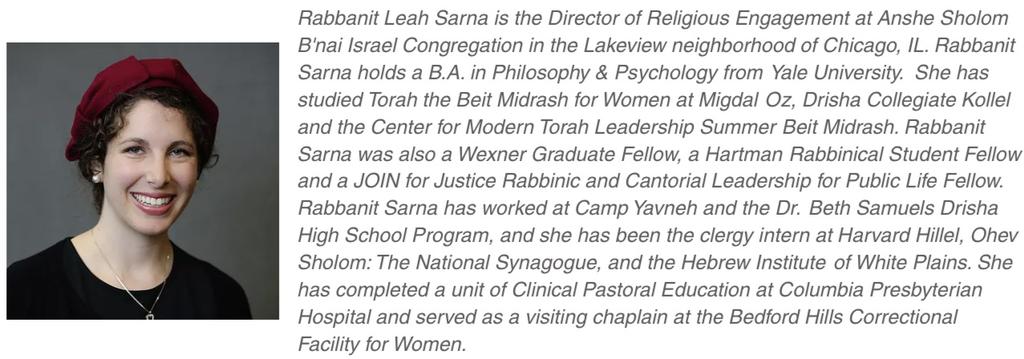
Rabbanit Leah Sarna
Class of 2018
Rabbanit Leah Sarna’s List of Feminist Tweaks to the Ashkenazi Orthodox Wedding:
Shabbat Kalla
- Partnership Minyan/Women’s Tefillah:
-
Called up to the Torah as a Kallah.
-
Honor female friends and family with aliyot and roles in the service
-
-
Dvar Torah in Shul by Kallah or a female friend
-
Carry Sefer Torah / Recite Mi Sheberachs / make kiddush / any ritual roles women play in your synagogue
-
Divrei Torah and toasts at meals by female friends
-
Zemirot leaders for meals
-
Kiddush, Hamotzi, Zimmun as honors for female friends
Kallah’s Tisch
-
Attendees: consider inviting anyone who wants to join!
-
Female tisch leader
-
Toasts/Brachot by women
-
Kallah’s Dvar Torah (and/or Siyyum)
-
Women prenup witnesses and notary (this can also be done in advance of the wedding)
-
Women witnesses to marriage license
-
Women witnesses to a brit ahuvim / other non-halakhic documents crafted by the couple in addition to their traditional Ketubah (which must be signed by men).
-
Tenaim at the Kallah’s Tisch
-
Witnessed by men
-
Document read by women (can be read in Hebrew and English)
-
Plate broken by mothers (fathers are welcome to join too!)
-
-
Mincha at the Tisch (Kallah says vidui at Shacharit)
Chatan’s Tisch
-
Attendees: consider inviting anyone who wants to join!
-
Ketubah can be completed by a woman
-
Toasts by female friends
-
Female song-leaders
Bedekin
-
Kallah helps the chatan into kittel or other special garments he might wear at the Huppah
Parents and grandparents of the couple give them brachot
Chuppah
-
Wedding band includes female musicians and singers
-
Chatan’s friends of all genders accompany him, Kallahs friends of all genders accompany her
-
Women honored by holding chuppah poles, symbolic founders and mainstays of your home
-
Female Mesaderet Kiddushin officiates
-
Female MC calls up witnesses, announces honors, etc.
-
Circles
-
Most authorities feel that the circles are unnecessary. The Chatan and Kallah can split the circles, they can be omitted altogether, etc.
-
-
Birkat Erusin
-
Some believe that women can recite this blessing.
-
-
Kiddushin
-
In advance of Kiddushin, officiant can ask the Kallah in earshot of witnesses if she is prepared to accept Kiddushin
-
Kallah can use “acceptance language” upon receiving her ring, such as “I hereby accept this ring as Kiddushin according to the law of Moses and Israel,” “הריני מקבלת טבעת זו בתורת קידושין כדת משה וישראל”
-
- Speech
- Call up a woman to give words of blessing to the Chatan and Kallah under their Chuppah. There are a number of appropriate moments for additional words of blessing, should you want to call up more than one speaker. Other times might include between the Ketubah and Sheva Brachot or after Sheva Brachot and before the breaking of the glass.
- Ketubah
-
The Ketubah can be read by a woman
The Kallah can give her husband a ring as part of his acceptance of the obligations of the Ketubah, endowing the Chatan’s ring with ritual meaning. This should be done in accordance with the instructions laid out by Rabbi Linzer (see footnote).
-
-
Ring As Gift
-
Kallah can gift a ring to her husband here or after Sheva Brachot. She can use any language to do so as long as it avoids language of Kiddushin. Common selections include “place me as a ring upon your heart,” "שמני כחותם על לבך" or “I am my beloved’s and my beloved is mine,” "אני לדודי ודודי לי" from Song of Songs
-
-
Sheva Brachot Under the Chuppah
-
Some believe that women can recite these Sheva Brachot.
-
Others recommend that men and women be called up in pairs, where the man says the bracha in Hebrew and a woman recites the bracha in English.
-
Others suggest that the man recites the Bracha in Hebrew and a woman recites some other text meaningful to the bride and groom.
-
Others suggest that after all the Sheva Brachot have been completed, women are called up to recite a poetic interpretation of the Sheva Brachot.
-
The blessing from Rav Amram Gaon’s Siddur is a beautiful addition at this point and can be recited by a woman.
-
- Breaking of the glass
-
If the Kallah is wearing appropriate footwear, she can break a glass
-
A female friend could lead the singing of Im Eshkachech
-
-
Recessional
-
Female friends should be explicitly invited to join in dancing the couple to the Yichud room
-
Yichud
- While women cannot be official witnesses, women could be honored as Yichud Guards
Sheva Brachot at the meal and beyond
- Many believe that women can recite Sheva Brachot at meals.