Pesach 5779 | April 2019
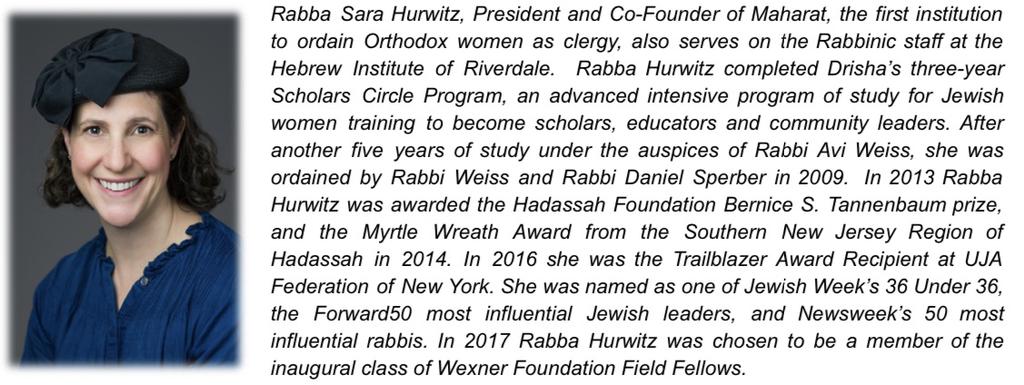
Rabba Sara Hurwitz
President and Co-Founder
“Anatomy Of Gratitude.” This is Brother David Steindl-Rast, a 90 year old Benedictine monk’s formulation of a how to be grateful, a practice increasingly explored by scientists and physicians as a key to joy and wellness. I was intrigued. The phrase put into words the way I have always thought about gratitude in Judaism-- as a full bodied experience. We don’t just say thank you to God, it is embedded into every formal prayer service. And we don’t just say words, we bend our bodies at the waist as we say “Modim anachnu lach” “Thank you God…” I always imagined that we feel such an overwhelming sense of gratitude that it bubbles up inside us, swirling towards the surface, causing our bodies to bow, spilling out our gratitude directly to God.
This, I believe, is the intent of the song Dayenu. A highlight of my seder, Dayenu is the crowning moment of the maggid section -- a fifteen stanza song of praise to God. The first five stanzas expound on our gratitude to God for taking us out of Egypt, the next five outline the miracles bestowed on us in the midbar (the wilderness), and the final five are an expression of gratitude for the ritual and spiritual staples in our lives -- the Torah, Israel, the building of the Beit Hamikdash. And, as we sing each stanza of Dayenu, the song is also meant to evoke a full bodied experience. In fact, the Vilna Gaon, in his commentary on the Haggadah teaches that the fifteen stanzas of Dayenu are parallel to the fifteen steps of the Beit Hamikdash that the Leviim ascended each day as they sang the Songs of Ascents, songs of praise and gratitude to God. As we sing each stanza of Dayenu, perhaps we are meant to cultivate within ourselves a complete and utter sensation that we might not be sitting at this seder, surrounded by these particular people, were it not for God’s grace.
This message of Hakarat Hatov, of deep gratitude, is central to our understanding of the Pesach experience. The Midrash (Shemot Rabba 1:8) explains that when the Torah tells us that a melech chadash (a new king) arose in Egypt after Yosef’s death, it was merely the same Pharaoh, who had forgotten all that Yosef had done for him. His gratitude had dissipated, and this set off the events that led to our slavery. The Midrash teaches “One who has no gratitude is comparable to one who negates the existence of God.” And each year, we must utilize gratitude as the tool to bring a sense of Godliness into the world. How?
Brother David Steindl-Rast offers a simple methodology for this kind of full bodied gratitude: Stop, look, go. In the bustle of our busy lives, it is hard to pause and take stock of all our blessings. The seder night calls on us to hit the pause button -- to just sit and reflect. Then, we are asked to look -- to notice how the stories of our past have constructed the world we inhabit today. But stopping and looking are not enough. We cannot just sit and relish the goodness that has been bestowed on us. We must go. We must acknowledge the blessings that God has given us, and pass them on to others. We must commit to opening our doors to strangers and those who have less than us. We must go out and learn (tze u’le’mad) what our ancestors have written for us. And, just as we praise God, we must praise and acknowledge with gratitude all those who have helped us on our journey.
On this Pesach, I am particularly grateful to the graduates of Maharat in the field who are teaching their Torah on college campuses, in Jewish organizations, in Orthodox congregations, and as chaplains. I am grateful to my students who are sitting day in and day out in our beit midrash simply because they want to serve the Jewish people. And I am grateful to our stellar faculty whose love for Torah is palpable. And of course, more than ever, I am grateful to Hakadosh Baruch Hu for the many blessings that have brought me here today. Dayenu.