


The Jubilee Year - Every fiftieth year there was to be no agricultural work, all landed property was to revert to its original owner, and slaves were to be set free
MISHNA: A Hebrew slave can be acquired by his master through money or through a document, and he can acquire himself, i.e., he is emancipated, through years, i.e., when he completes his six years of labor, or through the advent of the Jubilee Year, or through the deduction of money. The slave can redeem himself during the six years by paying for his remaining years of slavery. A Hebrew maidservant has one mode of emancipation more than him, as she acquires herself through signs indicating puberty. A slave who [by his own choice becomes a slave for "life"] acquires himself through the advent of the Jubilee Year or through the death of the master.
GEMARA: The mishna teaches that a Hebrew slave can be acquired through money. The Gemara asks: From where do we derive this law? . . .“Out of the money that he was bought for” (Leviticus 25:51). . . .
One who sells himself as a slave is sold for six years, and if he wishes he can be sold for more than six years, whereas one who is sold by the court is sold only for six years, but no more.
One who sells himself (into slavery) is not granted a severance gift by his master when he is emancipated, whereas one who is sold by the court is granted a severance gift. . . .
. . . . Rabbi Elazar says that there is no difference between these two types of slaves. Rather, both this slave and that slave may be sold for only six years; . . . both this and that one are granted a severance gift . . . .
. . . . The Gemara answers: He requires that verse to teach the following: “To him” means that one grants a severance gift only to the slave himself but not to his heirs. The Gemara asks: Why not give this gift to his heirs? After all, the Merciful One [God] calls a Hebrew slave “a hired worker.” Just as payment for the labor of a hired worker is given to his heirs when he dies, so too this severance gift for his labor should be given to his heirs when he dies.
Rabbi Eliezer ben Ya’akov derives the verbal analogy between “hired worker” and “hired worker,” why do I need this verse? Let him derive that a man sold by the court is released in the Jubilee Year . . . from the case of one who sold himself.
Rav Naḥman bar Yitzḥak said that this claim can be refuted: . . .The reason is that it might enter your mind to say that one who sells himself, who did not commit a transgression, is emancipated at the onset of the Jubilee Year even if six years have not passed, but with regard to one sold by the court, who did commit a transgression, as he was sold because he was unable to repay the value of his theft, one might say that we should penalize him and therefore he should not be emancipated in the Jubilee Year. Consequently, the verse teaches us that even this slave is emancipated in the Jubilee Year.
In what ways do Rav Nachman bar Yitzchak, Rabbi Eliezar ben Ya'akov, and Rabbi Elazar agree with one another? In what ways to they agree with the general premise put forth by the Gemara? In what ways to they disagree? In what ways are their perspectives different even if they arrive at the same or similar conclusions?
Most importantly:
What questions are these rabbis asking?
Rava bar Sheila said that the verse states “man.” What matter applies to a man and does not apply to a woman? [Choosing to become a slave "for life."]
Rabbi Ḥiyya bar Abba says that Rabbi Yoḥanan says: This is the statement of Rabbi Yosei HaGelili and Rabbi Akiva, who hold that a slave is not invariably freed whenever he is redeemed . . . But the Rabbis say that in every case, when he is emancipated it is to freedom.
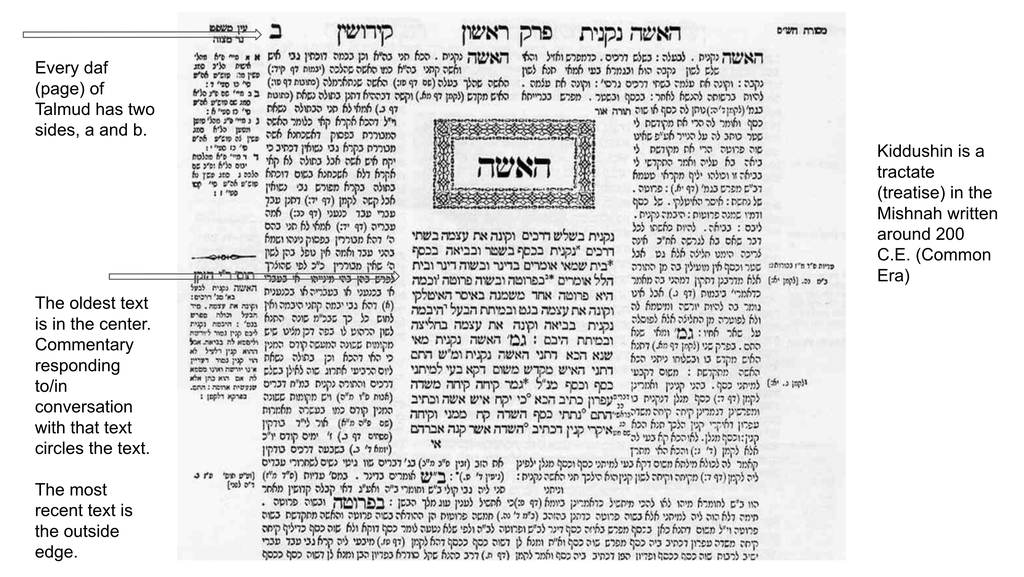
Some of these rabbis sat in a room together to discuss and debate the issues of slavery and reparations, but others only knew each other through the process of the oral tradition which was redacted and written and became the Talmud.
The Torah was the beginning of Jewish religious texts and the Talmud a continuation, but the Talmud is not the end.
The conversation continues.
1. Why do you think it might be relevant to Jewish people today to know that these revered sages wrestled with and debated and discussed issues like this one and raised so many questions?
2. Why do you think it might be relevant to Jewish people today to learn about these perspectives on slavery and reparations from so many years ago?
3. What questions do you have now that you have explored these texts?