


Shimon the Righteous was one of the last of the men of the great assembly. He used to say: the world stands upon three things: the Torah, the Temple service, and the practice of acts of piety (loving-kindnesses).
על גמ״ח כיצד הרי הוא אומר (הושע ו) כי חסד חפצתי ולא זבח. העולם מתחלה לא נברא אלא בחסד שנאמר (תהלים פט) כי אמרתי עולם חסד יבנה שמים תכין אמונתך בהם. פעם אחת היה רבן יוחנן בן זכאי יוצא מירושלים והיה רבי יהושע הולך אחריו וראה בית המקדש חרב [אר״י אוי לנו על זה שהוא חרב] מקום שמכפרים בו עונותיהם של ישראל. א״ל בני אל ירע לך יש לנו כפרה אחת שהיא כמותה ואיזה זה גמ״ח שנאמר כי חסד חפצתי ולא זבח
On acts of kindness. How so? It says (Hosea 6:6), “For I desire kindness, not a well-being offering.” The world was created from the very beginning with kindness, as it says (Psalms 89:3), “For I have said that the world will be built on kindness, and the heavens will be established on Your faith.” Once, Rabban [our rabbi] Yohanan ben Zakkai, left Jerusalem, and Rabbi Yehoshua followed after him. And he saw the Holy Temple destroyed. [Rabbi Yehoshua said: Woe to us, for this is destroyed –] the place where all of Israel’s sins are forgiven! [Rabbi Yohanan] said to him: My son, do not be distressed, for we have a form of atonement just like it. And what is it? Acts of kindness, as it says (Psalms 89:3), “For I desire kindness, not a well-being offering.”
And Rabbi Ḥama, son of Rabbi Ḥanina, says: What is the meaning of that which is written: “After the Lord your God shall you walk, and Him shall you fear, and His commandments shall you keep, and unto His voice shall you hearken, and Him shall you serve, and unto Him shall you cleave” (Deuteronomy 13:5)? But is it actually possible for a person to follow the Divine Presence? But hasn’t it already been stated: “For the Lord your God is a devouring fire, a jealous God” (Deuteronomy 4:24), and one cannot approach fire. He explains: Rather, the meaning is that one should follow the attributes of the Holy One, Blessed be He. He provides several examples. Just as He clothes the naked, as it is written: “And the Lord God made for Adam and for his wife garments of skin, and clothed them” (Genesis 3:21), so too, should you clothe the naked. Just as the Holy One, Blessed be He, visits the sick, as it is written with regard to God’s appearing to Abraham following his circumcision: “And the Lord appeared unto him by the terebinths of Mamre” (Genesis 18:1), so too, should you visit the sick. Just as the Holy One, Blessed be He, consoles mourners, as it is written: “And it came to pass after the death of Abraham, that God blessed Isaac his son” (Genesis 25:11), so too, should you console mourners. Just as the Holy One, Blessed be He, buried the dead, as it is written: “And he was buried in the valley in the land of Moab” (Deuteronomy 34:6), so too, should you bury the dead.
The Sages taught that acts of kindness are superior to charity in three respects: Charity can be performed only with one’s money, while acts of kindness can be performed both with his person and with his money. Charity is given to the poor, while acts of kindness are performed both for the poor and for the rich. Charity is given to the living, while acts of kindness are performed both for the living and for the dead.
(19) And then Abraham buried his wife Sarah in the cave of the field of Machpelah, facing Mamre—now Hebron—in the land of Canaan.
(יב) וַיֹּאמַ֓ר ׀ יְהֹוָ֗ה אֱלֹהֵי֙ אֲדֹנִ֣י אַבְרָהָ֔ם הַקְרֵה־נָ֥א לְפָנַ֖י הַיּ֑וֹם וַעֲשֵׂה־חֶ֕סֶד עִ֖ם אֲדֹנִ֥י אַבְרָהָֽם׃ (יג) הִנֵּ֛ה אָנֹכִ֥י נִצָּ֖ב עַל־עֵ֣ין הַמָּ֑יִם וּבְנוֹת֙ אַנְשֵׁ֣י הָעִ֔יר יֹצְאֹ֖ת לִשְׁאֹ֥ב מָֽיִם׃ (יד) וְהָיָ֣ה הַֽנַּעֲרָ֗ אֲשֶׁ֨ר אֹמַ֤ר אֵלֶ֙יהָ֙ הַטִּי־נָ֤א כַדֵּךְ֙ וְאֶשְׁתֶּ֔ה וְאָמְרָ֣ה שְׁתֵ֔ה וְגַם־גְּמַלֶּ֖יךָ אַשְׁקֶ֑ה אֹתָ֤הּ הֹכַ֙חְתָּ֙ לְעַבְדְּךָ֣ לְיִצְחָ֔ק וּבָ֣הּ אֵדַ֔ע כִּי־עָשִׂ֥יתָ חֶ֖סֶד עִם־אֲדֹנִֽי׃
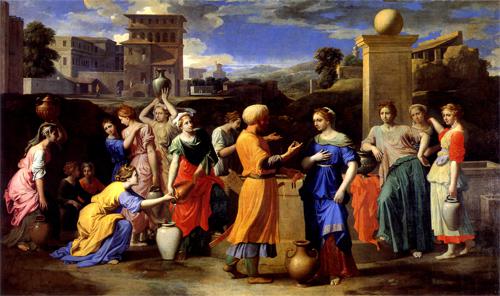
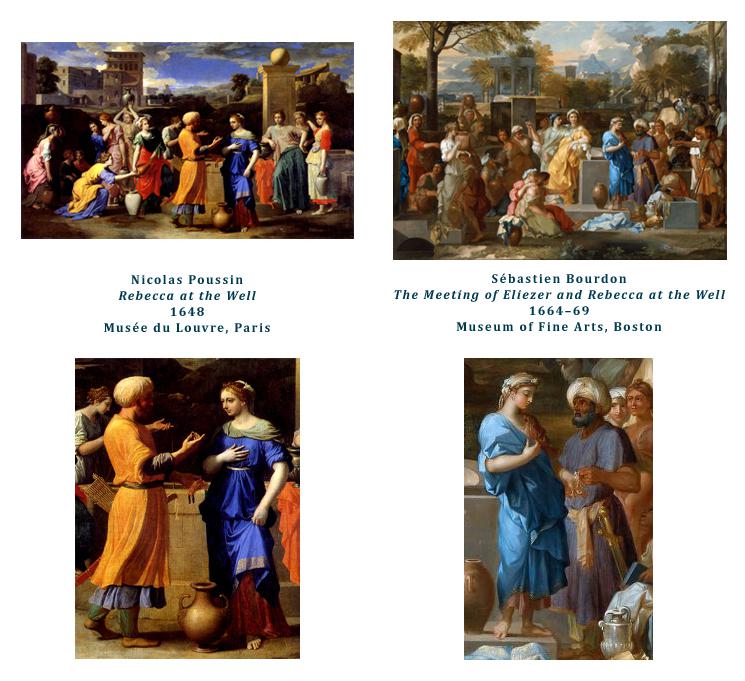
Rebecca at the Well, 1648
Musée du Louvre, Paris
June 1594 – 19 November 1665) He was the leading painter of the classical French Baroque style, although he spent most of his working life in Rome. Most of his works were on religious and mythological subjects painted for a small group of Italian and French collectors. (Wikipedia)
Sébastien Bourdon (2 February 1616 – 8 May 1671) was a French painter and engraver. His chef d'œuvre is The Crucifixion of St. Peter made for the cathedral of Notre Dame.
His steadfast love is eternal. (2) Praise the God of gods,
His steadfast love is eternal. (3) Praise the Lord of lords,
His steadfast love is eternal; (4) Who alone works great marvels,
His steadfast love is eternal; (5) Who made the heavens with wisdom,
His steadfast love is eternal; (6) Who spread the earth over the water,
His steadfast love is eternal; (7) Who made the great lights,
His steadfast love is eternal; (8) the sun to dominate the day,
His steadfast love is eternal; (9) the moon and the stars to dominate the night,
His steadfast love is eternal; (10) Who struck Egypt through their first-born,
His steadfast love is eternal; (11) and brought Israel out of their midst,
His steadfast love is eternal; (12) with a strong hand and outstretched arm,
His steadfast love is eternal; (13) Who split apart the Sea of Reeds,
His steadfast love is eternal; (14) and made Israel pass through it,
His steadfast love is eternal; (15) Who hurled Pharaoh and his army into the Sea of Reeds,
His steadfast love is eternal; (16) Who led His people through the wilderness,
His steadfast love is eternal; (17) Who struck down great kings,
His steadfast love is eternal; (18) and slew mighty kings—
His steadfast love is eternal; (19) Sihon, king of the Amorites,
His steadfast love is eternal; (20) Og, king of Bashan—
His steadfast love is eternal; (21) and gave their land as a heritage,
His steadfast love is eternal; (22) a heritage to His servant Israel,
His steadfast love is eternal; (23) Who took note of us in our degradation,
His steadfast love is eternal; (24) and rescued us from our enemies,
His steadfast love is eternal; (25) Who gives food to all flesh,
His steadfast love is eternal. (26) Praise the God of heaven,
His steadfast love is eternal.