12 Iyyar 5778 | April 27, 2018
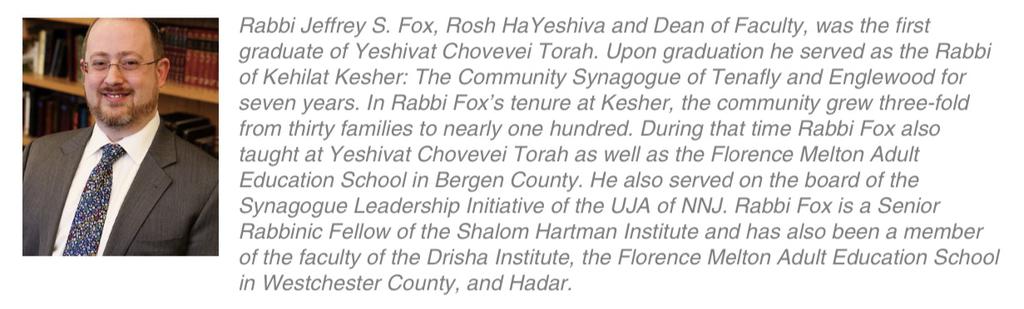
Rabbi Jeffrey Fox
Rosh Yeshiva
You shall love your neighbor as yourself (Vayikra 19:18) presents us with a core principle of the Torah. The Yerushalmi (Nedarim 43c) quotes a fundamental debate about the nature of Jewish life. Rebbi Akiva claims that loving your neighbor is the "great principle of the Torah (כלל גדול בתורה)". On the other hand, Ben Azzai quotes from Genesis (5:1) This is the book of the generations of Adam, on the day that God created Adam, in the image of God He made Adam, as the “great principle of the Torah.”
Rabbi Yitz Greenberg has been teaching this text as an opening to the nature of Judaism for many years. What lies at the center of Jewish life? For Ben Azzai, the Torah’s core teaching is that we are each created in the image of God. In order to begin with the image of God, we have to place God at the center, and move human beings to the perimeter. Rebbi Akiva, on the other hand, places the human being at the center in terms of the “great principle of the Torah.” Is Judaism a theocentric religion or an anthropocentric religion?
To be clear, both Ben Azzai and Rebbi Akiva understand that the opposing value is also extraordinarily important in Jewish religious life. It is not the case that Rebbi Akiva is pushing God out of the equation, nor is Ben Azzai pushing human beings away. Rather, if they were forced to make a choice between two core values Ben Azzai would put God at the top of the list and Rebbi Akiva would put humanity on the top of the list.
This same dialectic appears in Rashi’s reading of the potential convert who came to Shammai and Hillel (Bavli, Shabbat, 31a) and asked to learn Torah on one foot. Shammai pushes away the potential convert with measuring stick in his hand. The gemara then says:
בָּא לִפְנֵי הִלֵּל, גַּיְירֵיהּ. אָמַר לוֹ: דַּעֲלָךְ סְנֵי לְחַבְרָךְ לָא תַּעֲבֵיד — זוֹ הִיא כׇּל הַתּוֹרָה כּוּלָּהּ, וְאִידַּךְ פֵּירוּשַׁהּ הוּא, זִיל גְּמוֹר.
The non-Jew came before Hillel and Hillel converted him saying, “What is hateful to you, do not do to your neighbor. That is the entire Torah, the rest is commentary, now go and study.”
If we take this short passage at face value, Hillel appears to have converted this non-Jew, and only afterwards entered into an educational process. The same process appears to be the case with all three potential converts who come to Shammai and Hillel. Perhaps this is the case because Hillel was the greatest Jewish educator of all time and he had confidence in his own ability to bring this person along the journey (this appears to be Rashi’s read).
Hillel’s formulation of the central principle of the Torah, the elevator pitch of Judaism, is different from both Ben Azzai and Rebbi Akiva. Though Hillel seems to place human beings at the center, he does so with a negative formulation. The Torah, in this week’s parasha, says that we must love our fellow as ourselves. Hillel pushes us to look inside first. Religious life starts with my own experience, according to Hillel - “that which is hateful to you…”
Rashi, commenting on Hillel’s aphorism, offers two competing readings of the word "Your fellow - ריעך". The second opinion that he quotes is in line with Rebbi Akiva:
ריעך וריע אביך אל תעזוב (משלי כז) זה הקב"ה אל תעבור על דבריו שהרי עליך שנאוי שיעבור חבירך על דבריך ל"א חבירך ממש כגון גזלה גנבה ניאוף ורוב המצות:
“Do not abandon your Friend and your father’s Friend” (Proverbs 27) — this is the Holy blessed One. Do not violate God’s words, for it would be hateful to you if your friend would violate your words.
This read imagines that “Your fellow” actually refers to God. Rashi has brought Ben Azzai’s theocentric worldview to Hillel’s conversation with the convert. According to this approach, the first question to ask is: what might God want? What is demanded of me by the Halakha?
Different ideas of what Hillel might have meant when he was speaking to these potential converts present us with fertile ground to understand what each of us imagine to be the core of Jewish religious life. The opportunity to work with potential converts is both a great responsibility and wonderful gift. The passage in Masechet Shabbat concludes:
לְיָמִים נִזְדַּוְּוגוּ שְׁלָשְׁתָּן לִמְקוֹם אֶחָד, אָמְרוּ: קַפְּדָנוּתוֹ שֶׁל שַׁמַּאי בִּקְּשָׁה לְטוֹרְדֵנוּ מִן הָעוֹלָם, עִנְוְותָנוּתוֹ שֶׁל הִלֵּל קֵרְבַתְנוּ תַּחַת כַּנְפֵי הַשְּׁכִינָה.
Eventually the three [converts] happened to meet somewhere and said to each other: "Shammai's strictness would have killed us. Hillel's humility brought us under the wings of the divine presence."
In a fascinating combination, Rashi’s two reads bring together both Ben Azzai and Rebbi Akiva. Is Judaism theocentric or anthropocentric? Rashi says yes to both!