


1. What purpose does the Tabernacle/Mishkan serve for the People? What purpose does it serve for God?
2. Where (literally and figuratively) are the Israelites in their jouney? What challenges do they now face?
The reason why we find sometimes the objective mentioned first and other times the place of departure, is due to the fact that sometimes the people were glad to get away from a certain place where unpleasantness had occurred, whereas other times they were merely glad to arrive at a new destination hoping for a pleasant stay in their new encampment. One of the most vexing aspects of all these journeys was that the new objective had never been announced beforehand, so that the people were always in the dark about what the next day would bring. In spite of all these uncertainties they never refused to follow the cloud and break camp at a moment’s notice when required. The reason that both the breaking of camp and the making of camp are mentioned separately is because both entailed a considerable amount of discomfort.
1. What challenges is Sforno suggesting the Israelites are facing?
2. How might we apply this text and description of challenges to Jews today?
כי ענן יי על המשכן יומם ואש תהיה לילה בו, “for the cloud of the Lord would be over the Tabernacle by day, whereas by night fire would be above it.” We would have expected the Torah to write: ענן יי ביום ואש (ה') תהיה בלילה. Why did the Torah mention the word “fire” in front of the word “night” when describing the presence of heavenly attributes as manifest in connection with the Tabernacle? The reason is that the Torah wanted to use both “day” and “night” as divine attributes, respectively. (The word “day” is an alternate name for the attribute of Mercy, whereas the word “night” is an alternate name for the attribute of Justice).
It is well known that the name of the attribute of Mercy often appears with the letter מ being repeated, such as in the word יומם, [usually translated as “by day.” Ed.] The basic letters in the word לילה are ליל, the letter ה at the end being the allusion to the attribute of Justice which is most active at night.
1. What are the mechanics of traveling while being led by the pillar of cloud and the pillar of fire?
2. Is attributing Mercy to day and Justice to night an appropriate metaphor? Why or why not?
3. What is the place of Justice and Mercy in the current situation of Ukrainian Jewry? For the Ukrainian people generally?
(ד) עוד יתכן על פי דרך זה באומר כל איש ישראל פירש ענין היות כלם צדיקים והוא כי ישראל נקרא גוי אחד ונפש אחד כמה דאת אמר שבעים נפש שהוא להיותם משורש הקדושה שהיא אחדות שלימה ועל כן ישראל ערבים זה לזה יחשבו כל איש ואיש מישראל כאשר אחד מגוף שלם וכל הכללות כגוף מקובץ מאברים רבים ונפשותם כנפש א' המחיה את כלם יחד. ...
ועוד שע"י האחדות בלב ונפש בקרבך קדוש כי הוא יתב' שורה על נפש בעל אחדות בקרבו וזה אני חפץ שיהיו היכל יי המה שהאנשי' עצמם יהיו המקדש וההיכל ולא העיר והבית
It can further be explained along these lines that when the Torah says, "Kol Ish Yisrael", "Kol" refers to all of the component parts that make "Ish Yisrael", the "person of Israel" which functions when all of the component parts are righteous. Thus Israel is referred to as "one nation" and "one soul", and the seventy souls who come down to Egypt are the root of the holiness which is the complete unity of the whole nation. Therefore all of Israel is intertwined with each other, and each person is considered like one piece of the complete body, and all of the groups are like systems within the body, and all of their souls are like one soul which brings them all to life together. And furthermore, because of the unity of heart of the nation, the soul placed within it will be holy because it rests within a united organism. This is the ultimate desire: that this body will serve as the sanctuary of God, that the people themselves will be the Mikdash and the sanctuary, rather than the city and the building.
1. How is Alshich explaining Kol Ish Yisrael? What are the different stages of the Israelites' development he descibes?
2. Given that Jews are scattered all over the world do we have anything that stands in for the Tabernacle and/or Sanctuary? Does unity among Jews matter?
-
והוא עניין "כל ישראל ערבים זה לזה" (שבועות לט) שזכרו חז"ל, כי הנה על ידי זה נמצאים מתקשרים קצתם בקצתם ולא נפרדים איש לעצמו. והנה מידה טובה תמיד מרובה, ואם נתפסים זה על זה בחטא, כלשכן שיועילו זה על זה בזכות
The Talmud (Shevuot 39a), in discussing the domino effect of sin, concludes with the Aramaic phrase, Kol yisrael arevim zeh bazeh, meaning all of Israel are responsible for each other. This phrase is the basis of the notion of communal responsibility in Jewish law. If one Jew sees another Jew at the verge of sinning, he has an obligation to step in and help. Even more so, it implies an obligation on all Jews to ensure that other Jews have their basic needs for food, clothing, and shelter taken care of. Simply by virtue of being a Jew one is responsible for the well-being of other Jews, and vice versa.
1.Alshich explains the meaning of 'Kol ish Yisrael," while Derekh Hashem brings in the classic phrase of Kol Yisrael arevim zeh bazeh. What are the differences and similiarities between the two phrases?
2. What is communal responsibility? What are our obligations to care for the basic needs of all Jews?
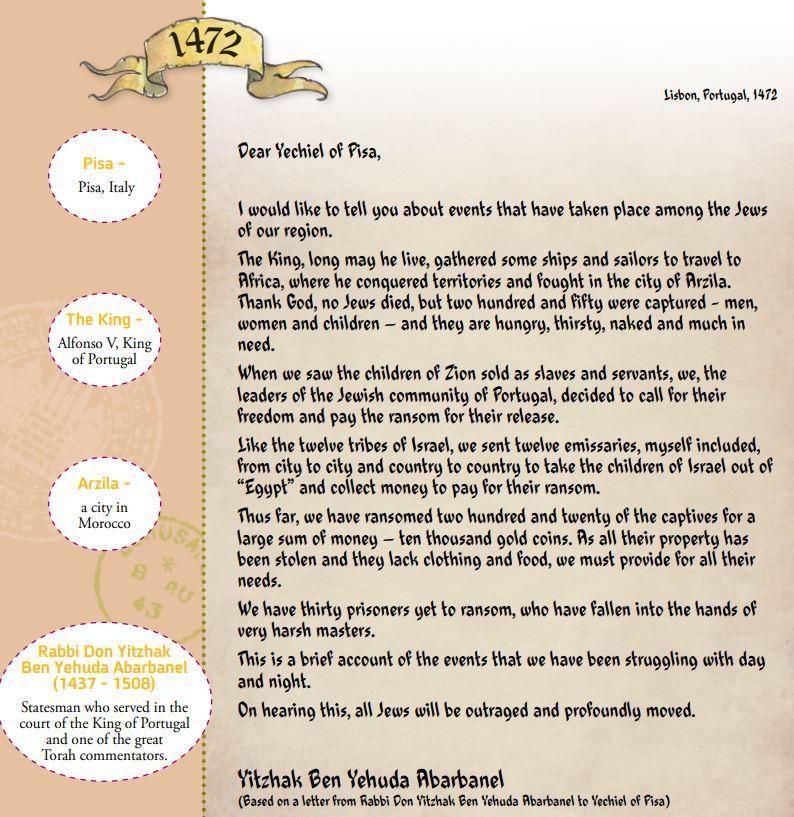
Excerpted from Friends across the Sea: A textbook about Jewish Peoplehood, TALI Education Fund, Curriculum Department, 2012.
1. What events is Abarbanel describing in his letter?
2. Does the assistance effort he describes parallel other major events in Jewish history?
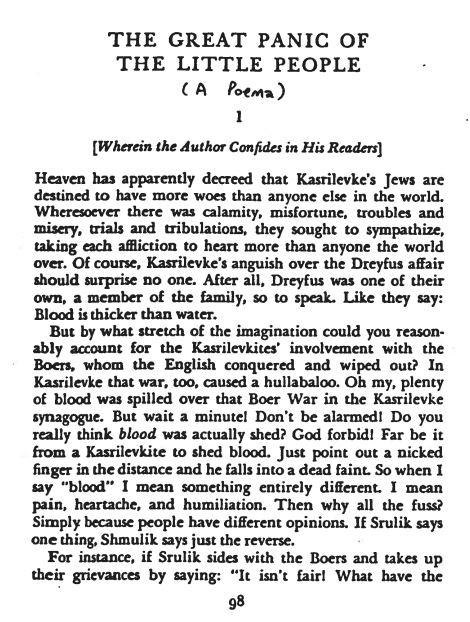

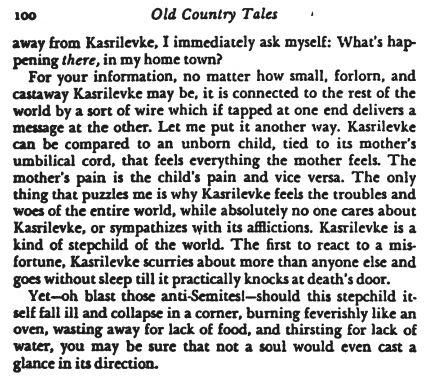
From "The Great Panic of the Little People" in Old Country Tales [by] Sholom Aleichem: Selected and Translated, with an Introd. by Curt Leviant; Putnam, 1965.
Sholem Aleichem (1859-1916) grew up in the shtetl of Voronkiv, in the Poltava Governorate of the Russian Empire (now in the Kyiv Oblast of central Ukraine)
1. What tone does Aleichem take in the story? What sense does it give you of the community he depicts?
2. Is Kasrilevke comparable to a communtiy with which you are familiar? Does it describe the broader Jewish community today? Why or why not?