9 Nisan 5777 l April 5, 2017
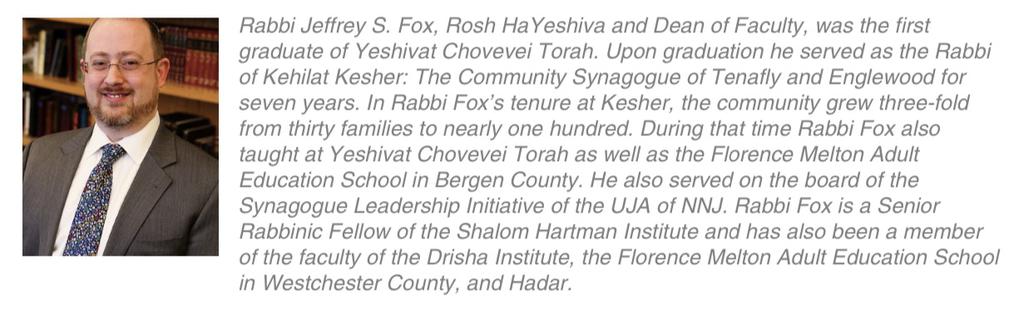
Rabbi Jeffrey Fox
Rosh HaYeshiva and Dean of Faculty
We have explored some fundamental sugyot on the fluid nature of Jewish identity. The gemarot about a man who was circumcised but not (yet) immersed (מל ולא טבל) present us with a compelling model that Rav Yosef Engel built on to allow for the existence of an in-between personal status. The observance of Shabbat then became an acid test that forced us to make a decision as to whether a given person is Jewish or not.
This then raised the following question– what happens if after an adult man is circumcised for conversion he may not, for medical purposes, go into the mikvah for two or three weeks? How ought the potential convert behave in the interim, until his conversion is entirely completed, regarding Shabbat? There are three potential answers that one might give to this question:
- A man at this stage– between circumcision and immersion– might be treated as a non-Jew, and therefore prohibited from observing Shabbat.
- Perhaps a man at this stage should be obligated to observe Shabbat full like a Jew.
- Finally, maybe this man is permitted, though not yet obligated to observe Shabbat.
It is this question that animated a cohort of major poskim in the second half of the 19th century. The story begins with the arrival of a potential convert in Jerusalem towards the beginning of the year 1848. Rav Shmuel Salant was the head of the Ashkenazi beit din in Jerusalem at the time, and functioned as the posek of Jerusalem.
Soon after Purim, in March of 1848, a potential convert came to the beit din in Jerusalem and was prepared to complete the process. At this time, Rav Salant was travelling in order to raise money for the Yishuv. He had appointed Rav Asher Lemel as the interim head of the beit din. The circumcision took place on Tuesday March 28th in the presence of the Jerusalem beit din under the auspices of Rav Asher Lemel.
By the time the following Shabbat arrived, just four days later, parashat ha-chodesh, the convert had not fully healed and he did not yet go to the mikvah. After mincha members of the beit din came to Rav Lemel and ask him how this man should relate to Shabbat. It was already seuda shlishit and Rav Lemel had to respond immediately. He told the emissaries of the beit din that this man must violate Shabbat.
They then showed up at the convert’s home and relayed the position of Rav Lemel. The convert picked up a pen and, with tears in his eyes, began to write. The next day the rabbis in Jerusalem were up in arms. How could Rav Lemel have made such a psak? The Sephardi beit din was particularly upset. Rav Lemel passed away in November of 1850, about two and a half years later. However, he was able to send several letters to Rabbi Yaakov Ettlinger is Altona, Germany summarizing the events that took place and outlining his own position.
The letters sent to Rav Yaakov Ettlinger were originally published in a bi-weekly magazine known as שומר ציון הנאמן (June of 1853, numbers 154– 158, posthumously). This magazine was the first attempt to have a “parasha sheet” in the Jewish community. Rav Ettlinger collaborated with Dr. Shmuel Yosef Enoch to publish regular Halakhic and philosophical content from leading thinkers and rabbis. This was also part of Rav Ettlinger’s opposition to the Enlightenment and Reform in Germany in the middle of the 19th century. Many of these essays ended up in Rav Yaakov Ettlinger’s teshuvot, ערוך לנר. Some of Rav Lemel’s original question was subsequently published Aruch la-Ner #126.
Most of Rav Lemel’s position appeared as the question to Rav Ettlinger. However, a more complete version of his position was sent to Germany and published in several editions of shomer tzion ha-ne’eman. In 1986, the Kollel Institute of Greater Detroit published a volume of essays in honor of Rabbi Shlomo Nussbauam called יד שלמה. They did us all a great service and re-published, in full, many of the essays from that time.
Rav Lemel’s position is built on a simple read of the gemarot about circumcision and Shabbat. Given that the gemara says explicitly that without both circumcision and immersion a potential convert is basically still not Jewish and the general prohibition for a non-Jew to observe Shabbat– Rav Ashem Lemel gave what appears to be the most straight forward answer.