


This August, as Jews observe Tisha b'Av, the day on which we commemorate the destruction of the Temple in Jerusalem and the beginning of Jewish exile and Diaspora, Afghans around the world will be marking one year since the fall of Kabul. We don't know yet what the future holds for Afghanistan and its capitol, but we know that for tens of thousands of displaced Afghans the events of August 2021 were the beginning of a new and difficult chapter in their lives. The text study juxtaposes texts from the Book of Lamentations, with its graphic descriptions of a conquered Jerusalem, with stories and images from Kabul as it fell to the Taliban.
Following the text study, this resource includes an English-language 6th chapter of Lamentations, written to express our mourning and despair at the contemporary refugee crisis - this year for the first time there are more than 100 million displaced people on Earth. It is designed to be read in Eicha trop following the communal reading of Eicha on Tisha b'Av. It can also be used as part of the text study, or studied independently.
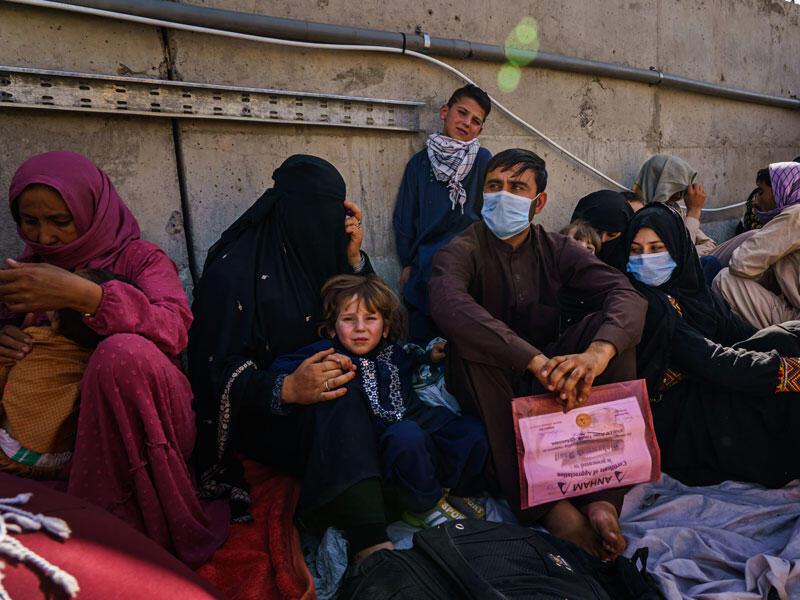
A family sits on the side to shelter from the sun at the East Gate of the airport in Kabul, Afghanistan. Aug. 25, 2021.
(Marcus Yam/Los Angeles Times)
Discussion prompt:
Look closely at the people in the photograph.
Questions for Information: What are they wearing? What objects are they holding? In which direction are they looking? What is their body posture or position? What other details do you notice?
Questions for Interpretation: What relationships can you see or imagine between the people in the photograph? What do their facial expressions and body language communicate about how they are feeling? What stories can you tell about the moments before or after this picture was taken?
(3) Judah has gone into exile
Because of misery and harsh oppression;
When she settled among the nations,
She found no rest;
All her pursuers overtook her
In the narrow places.-b
Discussion Prompts:
- What in this verse from Lamentations is specific to a particular historical moment? What is (or could be) universal?
- (How) does reading this verse after looking at the LA Times photo shift your understanding of the text and/or the photo?
As the Taliban closed in on Kabul and Abdul and his family awaited safe passage from Afghanistan to the United States, they had to move frequently, never staying in one place for more than a day.
“They were supposed to kidnap my son,” said Abdul in a video released by Apartment List on November 30. “For two and a half months, I did not see my dad. I did not see my brothers, my sister, and everything.”
HIAS Blog, December 2, 2021
After Months on the Run, Afghan Family Finds Safety in New Home | HIAS
We are hotly pursued;
Exhausted, we are given no rest.
Discussion prompts:
- What is the central image, idea, or impression you are left with after reading each text?
- What connections do you see between these texts?
- (How) does drawing connections between the texts shift or deepen your understanding of either, or both, of them?
Some children arrived with no shoes on their feet, no diapers, with literally nothing. I saw a young girl around 4-years-old who had arrived barefoot having her feet treated because the skin had been torn by the hot, sharp rocks at the base, her first steps on free soil literally burning her soles.
Andrea Gagne, HIAS Blog, Dispatch: Welcoming Afghans Who Made It to the U.S. | HIAS
My heart is in tumult,
My being melts away-g
Over the ruin of my poor people,-h
As babes and sucklings languish
In the squares of the city.
Discussion prompts:
- What is the central image, idea, or impression you are left with after reading each text?
- What connections do you see between these texts?
- (How) does drawing connections between the texts shift or deepen your understanding of either, or both, of them?
“Do you know where the president is?” asked Atmar, who had arrived just as the choppers were taking off.
“The president went home,” Bek answered.
“No. He ran away.”
“I don’t believe it. I just saw him.”
“Look,” Atmar said, pulling out the passport with the seal of the republic on the cover. “He’s gone.”
Matthieu Aikins, "Inside the Fall of Kabul," NY Times Magazine, December 12, 2021
https://www.nytimes.com/2021/12/10/magazine/fall-of-kabul-afghanistan.html
He has smashed her bars to bits;
Her king and her leaders are in exile,-e
Instruction is no more;
Her prophets, too, receive
No vision from the LORD.
Discussion prompts:
- What is the central image, idea, or impression you are left with after reading each text?
- What connections do you see between these texts?
- (How) does drawing connections between the texts shift or deepen your understanding of either, or both, of them?
As we observe Tisha B’Av and commemorate the destruction of Jerusalem that led to the exile of the Jewish people for centuries to come, we are acutely aware that we find ourselves in the midst of the worst refugee crisis in recorded history, with more than 100 million people displaced worldwide. ... This text is a modern addition to the book of Lamentations – a 6th chapter – meant to express our mourning over the contemporary refugee and asylum crises and to acknowledge and lament our country's failing those who have turned to us.
Please note that, because the text is in English, rather than Hebrew, some of the trope markings will appear backwards (e.g., munach, mapach, etc.)
Eicha – Al֣as! A cou֝ntry once bui֙lt on the pro֗mise of lib֖erty and jus֥tice for a֑ll
now isol֤ates her֝self fr֣om the cri֔es of tho֖se seeking saf֥ety on֣ her shoֽres.
Bui֤lt by the ha֝nds of ref֣ugees and immig֔rants, she
ch֖ips aw֥ay at the r֖ight to asyl֑um,
disp֝ensing with fou֣nding prin֔ciples so
ess֖ential as her DNֽA.
For֝gotten are the tir֙ed, the po֗or, the hu֖ddled masses yea֥rning t֣o breathe frֽee.
G֝one is the dre֙am of prot֗ection in the fa֤ce of viol֝ence a֣nd persec֔ution.
“H֖er ene֥mies are no֖w the mastֽers” (1:5).
Inhum֝ane exe֤cutive ord֝ers bar֖ring Mus֥lims an֣d ref֑ugees.
Jar֛ringly sepa֖rating par֥ents fro֣m childֽren.
Kee֝ping out compa֙ssion and dece֗ncy, a w֖all in their pla֑ce.
La֖dy Liberty we֥eps at her shut֖tered gatֽes.
Mi֝xed multit֤udes we we֝re whe֣n we left Mitzr֗ayim, the nar֖row pla֑ce;
no֛w, the world narr֤ows around the 70֣ millio֔n disp֖laced pe֥ople aro֣und the gloֽbe. On֝ly Go֤d’s voi֝ce ca֣n be hea֔rd bello֝wing ca֣lls to welc֔ome,
pro֖tect, and lo֥ve the stra֑nger –
part֛ners in con֖tinued rede֥mption we a֣re no longeֽr.
Quie֗t in the fa֝ce of mo֣ral depr֔avity ar֖e her citiz֑ens,
reinf֛orced by hat֖eful rhe֥toric spe֖wed from se֖ats of powֽer.
Self-e֝vident tru֙ths –
that hu֤man bei֝ngs are cre֣ated eq֔ual, end֝owed by֣ their Cre֔ator
w֖ith cer֥tain unalie֣nable righ֑ts –
und֖one by cowa֥rdice, mal֣ice, and greֽed.
Ve֗rily, we kn֝ow wh֣ere God dw֔ells am֖idst this suffe֑ring –
Go֛d is in the ey֖es of those flee֥ing for֣ their liveֽs.
Why, th֝en, hav֤e we forsa֝ken the D֣ivine call
to lo֤ve the stra֝nger as֣ we wo֔uld lo֖ve ourse֑lves –
xenop֖hobia inst֥ead taking ro֖ot in our soֽuls?
Yo֝u are the he֙ro fo֣r who֔m you֣ are sear֑ching:
Zi֝on can֤not be returne֝d to if we֖ do not first t֥urn to those ca֣lling our naֽmes.
https://www.hias.org/sites/default/files/lamentations_6.pdf