


סיום דף היומי על מסכת נדרים
מכון פרדס
ג׳ שבט תשפ’’ג
Siyum on Masechet Nedarim
Pardes Institute of Jewish Studies
25 January 2023 / 03 Sh'vat 5783
בָּרִאשׁוֹנָה הָיוּ אוֹמְרִים, שָׁלשׁ נָשִׁים יוֹצְאוֹת וְנוֹטְלוֹת כְּתֻבָּה, הָאוֹמֶרֶת טְמֵאָה אֲנִי לְךָ, שָׁמַיִם בֵּינִי לְבֵינֶךָ, נְטוּלָה אֲנִי מִן הַיְּהוּדִים. חָזְרוּ לוֹמַר, שֶׁלֹּא תְהֵא אִשָּׁה נוֹתֶנֶת עֵינֶיהָ בְאַחֵר וּמְקַלְקֶלֶת עַל בַּעְלָהּ. אֶלָּא הָאוֹמֶרֶת טְמֵאָה אֲנִי לְךָ, תָּבִיא רְאָיָה לִדְבָרֶיהָ. שָׁמַיִם בֵּינִי לְבֵינֶךָ, יַעֲשׂוּ דֶרֶךְ בַּקָּשָׁה. נְטוּלָה אֲנִי מִן הַיְּהוּדִים, יָפֵר חֶלְקוֹ, וּתְהֵא מְשַׁמַּשְׁתּוֹ, וּתְהֵא נְטוּלָה מִן הַיְּהוּדִים:
Initially the Sages would say that three women are divorced even against their husbands’ will, and nevertheless they receive payment of what is due to them according to their marriage contract... The second is a woman who says to her husband: Heaven (is) between me and you. They subsequently retracted their words and said that in order that a married woman should not cast her eyes on another man and to that end ruin her relationship with her husband and still receive payment of her marriage contract, these halakhot were modified as follows: ...as for a woman who says: Heaven (is) between me and you, the court must act and deal with the matter by way of a request (a banquet?), rather than force the husband to divorce his wife.
The Mishna presents three situations where a woman can use the halacha to compel her husband to divorce her and still receive her ketubah pay out. I am interested in the middle scenario, where the first (part of the) Mishna suggests that just saying “שמים ביני לבינך” is enough for the divorce to happen.
The Sages became worried that women might use this mechanism to get out of marriages if they desired someone else. They revised the system and under the new rules presented in the second (part of the) Mishna, if a women uses the “שמים ביני לבינך” clause, the husband is advised to attempt to reconcile the relationship (דרך בקשה), perhaps with a meal designed to bring the two closer together. This is very different to the first (part of the) Mishna, which seems to have accepted the claim of the woman without challenge and forced the husband to give the wife a get.
Another interpretation of “דרך בקשה” is that we believe the woman who says “שמים ביני לבינך”, but not enough to compel the husband to divorce her. Rather, the court will ask/request the man to divorce her wife, but we do not force him against his will, as the first (part of the) Mishna instructs (according to Rashi's understanding).
The phrase “שמים ביני לבינך” caught my attention and I wanted to explore it further.
The Mishna recognises estrangement between a husband and a wife and allows the woman to divorce her husband, even against his will, whilst protecting her ketubah payout. This mechanism is revolutionary not only legally, but also psychologically.
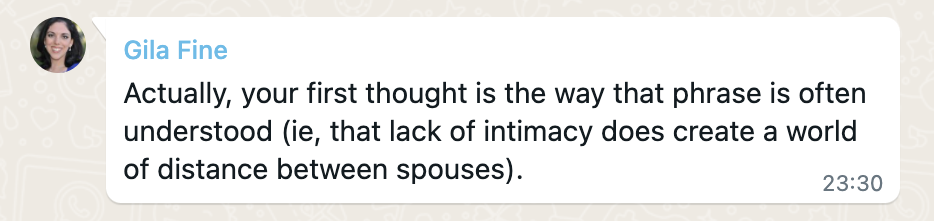
The literal language of "heaven (is) between me and you" evokes a rift and unbridgeable distance.
Surprisingly, nowhere in the Bavli. There are two places where this phrase can be found in Yerushalmi; one is a brief appearance in Y. Sotah 1:3 and the other is the parallel sugya to our source text in Y. Nedarim 11:12.
The parallel sugya can be seen below:
Heaven (is) between me and you: as heaven is far from earth, so far be this woman from that man. ... Rav Huna said, they should have dinner and they will get accustomed to be with one another...
רָגַל (b. h.) to move on, run.—[Part. pass., v. רָגוּל.]
Hithpa. - הִתְרַגֵּל to accustom one’s self, get used to... Y. Ned. XI, end, 42ᵈ יעשו סעודה והן מִתְרַגְּלִין לַבָּא וכ׳ (some ed. לבוא) let a banquet be arranged, and they (the disaffected couple) will get used in future to associate with each other through the influence of the banquet.
There are, however, two very different approaches that the P'nei Moshe and Korban haEdah take in their interpretation.
כן תהא האי איתתא רחיקה. גי' הר"ן כן האי איתתא רחיקא כלומר שאומרת שהיא מרוחקת ממנו ואינו משמש עמה ולגירסת הספר תהא שאוסרת עצמה עליו:
So far be this woman: ...this is to say that she would say that she is distanced from him and he really is not with her...
והן. מתרגלין לבוא. לפיוס או לתשמיש ע"י הסעודה:
They: Will get accustomed. To reconcile or to engage in sexual intercourse thanks to the meal.
Not really. Whilst P'nei Moshe seems to echo the sentiment of distance and estrangement, Korban haEdah brings in an attempt at fixing their rift via shared meals.
Let us look at the Gemara in Bavli on the Mishna I cited initially. This is a fascinating sugya which will eventually touch on the question of “שמים ביני לבינך”. I compared this to a Talmudic tango, because it is a fine legal dance between two opinions, full of twists and turns in forms of challenges and refutations.
אִיבַּעְיָא לְהוּ: אָמְרָה לְבַעְלָהּ ״גֵּרַשְׁתַּנִי״, מַהוּ?
אָמַר רַב הַמְנוּנָא: תָּא שְׁמַע: הָאוֹמֶרֶת ״טְמֵאָה אֲנִי לָךְ״, דַּאֲפִילּוּ לְמִשְׁנָה אַחֲרוֹנָה דְּקָתָנֵי לָא מְהֵימְנָא — הָתָם הוּא דִּמְשַׁקְּרָה, דְּיָדְעָה דְּבַעְלַהּ לָא יָדַע בָּהּ. אֲבָל גַּבֵּי ״גֵּרַשְׁתַּנִי״ דְּיָדַע בָּהּ — מְהֵימְנָא, דַּחֲזָקָה אֵין אִשָּׁה מְעִיזָּה פָּנֶיהָ בִּפְנֵי בַּעְלָהּ.
אֲמַר לֵיהּ רָבָא: אַדְרַבָּא, אֲפִילּוּ לְמִשְׁנָה רִאשׁוֹנָה דְּקָתָנֵי מְהֵימְנָא — הָתָם מִשּׁוּם דְּלָא עֲבִידָא לְבַזּוֹיֵי נַפְשַׁהּ, אֲבָל הָכָא דְּזִמְנִין דִּתְקִיף לַהּ מִן גַּבְרָא — מְעִיזָּה וּמְעִיזָּה.
מֵתִיב רַב מְשַׁרְשְׁיָא: ״הַשָּׁמַיִם בֵּינִי לְבֵינָךְ״ דְּמִשְׁנָה רִאשׁוֹנָה — תְּיוּבְתָּא דְּרָבָא, הָכָא דְּלֵית לַהּ כִּיסּוּפָא, וְקָתָנֵי דִּמְהֵימְנָא!
A dilemma was raised before the Sages: If a woman said to her husband: You divorced me, ...is she believed or not?
Rav Hamnuna said: ...concerning the claim: You divorced me, with regard to which he knows the truth about whether or not he actually divorced her, she is believed. Why? Because the court relies on the presumption that a woman is not brazen enough to lie in the presence of her husband and present a claim that he knows is patently false.
Rava said to Rav Hamnuna: On the contrary, even according to the initial version of the Mishna that teaches that the woman is believed in her claim that she is defiled to her husband, it may be argued that it is only there that she is believed, because a woman would not demean herself by claiming she was raped if she were not telling the truth. But here, where it is sometimes hard for her under the authority of the man, i.e., her husband, she would be brazen to his face, and therefore the court does not believe her.
Rav Mesharshiyya raised an objection: Let the ruling of the initial version of the Mishna, with regard to a woman who says: Heaven (is) between me and you, be a conclusive refutation of the opinion of Rava, as here she suffers no embarrassment on account of her claim, and yet the Tanna teaches that she is believed.
Before the Gemara starts to discuss the meaning of the phrase “שמים ביני לבינך”, it asks another question.
If a woman says to her husband in court: “גרשתני” (you divorced me!), is she believed or not?
Rav Hamnuna's position is that we believe her regarding the question of the divorce. He teaches that when the Mishna brought the case of a woman who claimed to have been violated, the first (part of the) Mishna [M1] ruled to believe her and the second (part of the) Mishna [M2] ruled not to believe her. The reason M2 ruled not to believe her was because the woman had an opening for lying to her husband, in that the husband had no way of knowing whether she was violated or not. This, however, is different to the case of “גרשתני”, where Rav Hamnuna believes her, because a husband knows whether they divorced or not. We assume that a woman would not have the audacity to lie to her husband's face about a matter he has knowledge on.
Rava has an opposite view on the matter. He holds, that when the Mishna brought the case of a woman who claimed to have been violated, M1 only believed her because she had to say something undesirable and uncomfortable. We presume that she would not have made such statement up, as it degrades her. Contrastingly, in the case of “גרשתני”, Rava's position is that we do not believe her, because saying “שמים ביני לבינך” is not a traumatic experience. Moreover, women are emotional and anger might overcome them to the point where they would in fact have the audacity to lie to the face of their husbands about a matter he has knowledge on.
Rav Msharshiya challenged Rava's position. He teaches that in the case of “שמים ביני לבינך”, M1 believes her and she is allowed to go with her ketuba. This surely is a refutation of Rava, because the woman is seemed to be believed in absence of an unpleasant and undesirable experience! Rava claimed that she was to be believed only due to the traumatic nature of the experience, and it is absent in this case.
At this point, it might be worthwhile to investigate, what the commentators understand the phrase “שמים ביני לבינך” to mean. It is this phrase, which we saw in the Mishna, that inspired me to put this source sheet together.
Before carrying on, I would like to ask what the phrase “שמים ביני לבינך” evokes in you.
Is your idea divorced from the context different to your interpretation once you factor the circumstances of a woman seeking a divorce?
השמים ביני לבינך - כלומר לשמים גלוי דברים שביני לבינך שאין השכבת זרע יורה כחץ דאינו ראוי להוליד בבאה מחמת הטענה כדאמר סוף פרק הבא על יבמתו דקאמרה בעינא חוטרא לידא ומרא לקבורה דאל''כ אמרינן לה זילי לא מפקדת וסבירא לן למשנה ראשונה דמהימנא:
Heaven (is) between me and you - this is to say that to the Heaven are revealed things that are between me and you, that is the fact that the seed is not shot like an arrow and is thus incapable of fecundation...
השמים ביני לבינך - מוכח בגמ' דהכי קאמרה ליה שאין שכבת זרעו יורה כחץ בשעת תשמיש ואינו ראוי להוליד
ומתוקמא בבאה מחמת טענה דאמרה בעינא חוטרא לידא ומרא לקבורה הא לאו הכי אין בדבריה כלום דאמרי' לה זילי לא מפקדת כדאמרי' בפ' אע''פ (כתובות סד. ויבמות סה:) ואע''ג דאמרינן בהגדה שאמרה לו שרה אמנו לאברהם השמים ביני לבינך שנאמר ישפוט השם ביני ובינך דלמא היינו שהוא מרוחק ממנה לגמרי כגון שרה שהיתה טוענת על אברהם שריחקה מחמת הגר ובירושלמי נמי הכי משמע דאמרינן כמה דשמים רחיקתא מן ארעא כך ההיא אתתא רחיקתא מבעלה
אפשר דלשון השמים ביני לבינך כולל הכל אבל הכא מוכח בגמ' שפירושו שאינו יורה כחץ וכי קאמרה ליה השמים ביני לבינך הכי קאמרה אלקים עד ביני ובינך דקושטא קאמינא שדבר זה אין יודע בו אלא השם:
Heaven (is) between me and you - it is proven in the Gemara that what she is saying to him is that the seed is not shot like an arrow at the time of their relations and is unfit for impregnation... it is also possible that this phrase "Heaven (is) between me and you" includes everything, however, it is proven in the Gemara (spoiler alert), that the explanation [of the phrase] is that the seed is not shot like an arrow and when she is saying that "Heaven (is) between me and you", what she is saying is that this thing is not known anywhere other than by the Divine.
"שמים ביני לבינך" כלומר, טוענת טענה שאי אפשר להוכיחה, אלא היא ידועה לקדוש ברוך הוא בלבד, שאומרת שבעלה אינו בא עליה כראוי.
Heaven (is) between me and you - as to say that she claims something which cannot be proven, however, she knows that the Holy One alone knows that the husband does not come (sorry!) onto/into her appropriately.
The three interpretations of Tosfot, Ran and R' Steinsaltz all suggest that the phrase is not as profoundly inspiring as my initial reading. In all three cases, the commentators agree that the phrase is a euphemistic way of referring to male infertility.
The phrase “יורה כחץ”, unlike “שמים ביני לבינך”, is not unique to this masechet and makes an appearance in B. Chagiga 15a and B. Yevamot 65a:
Didn’t Shmuel say: Any semen that is not shot like an arrow cannot fertilize?...
The Gemara addresses a related case. If he said that the cause for their failure to have children is from her, i.e., it is she who is infertile, and she said it is from him, Rabbi Ami said: With regard to such matters between him and her, she is believed. The Gemara inquires: What is the reason for this ruling? She is certain whether his semen shoots like an arrow, whereas he is not certain whether his semen shoots like an arrow.
Prior to the detour into Tosfot, Ran, R' Steinsaltz and B. Chagiga, I presented a part of the Gemara on the last Mishna in masechet Nedarim. The Gemara wondered, whether a woman who says to her husband “גרשתני” (you divorced me!) is believed or not. Rav Hamnuna thinks yes, Rava thinks no and Rav Msharshiya has an issue with Rava, claiming that the Mishna already ruled that we believe the woman and therefore the Mishna is a challenge of Rava's position.
Rav Msharshiya moves from brazenness to embarrassment, which is why it was important to develop a deeper appreciation for the possible understandings of the phrase “שמים ביני לבינך”.
קָסָבַר רָבָא: הָתָם, כֵּיוָן דְּלָא סַגִּי לַהּ דְּלָא אָמְרָה ״אֵין יוֹרֶה כְּחֵץ״, אִי לָא אִיתָא כִּדְקָאָמְרָה — לָא אָמְרָה לֵיהּ.
״הַשָּׁמַיִם בֵּינִי לְבֵינָךְ״ דְּמִשְׁנָה אַחֲרוֹנָה, תִּהְוֵי תְּיוּבְתָּא דְּרַב הַמְנוּנָא: וְהָא הָכָא דְּיָדְעָה הִיא, וּבַעְלַהּ יָדַע בַּהּ, וְקָתָנֵי דְּלָא מְהֵימְנָא!
קָסָבַר רַב הַמְנוּנָא: הָכָא נָמֵי הִיא גּוּפָא אָמְרָה: נְהִי דִּבְבִיאָה יָדַע, בְּיוֹרֶה כְּחֵץ מִי יָדַע? וּמִשּׁוּם הָכִי מְשַׁקְּרָא.
The Gemara answers: Rava maintains that there, since it is not sufficient for her if she does not state in precise detail her claim that he does not shoot like an arrow, i.e., his semen is not emitted forcefully, then, were it not as she said, she would not say it. She would be too ashamed to speak of such things before the court. It is for this reason that she is believed.
The Gemara further comments: Let the ruling of the ultimate version of the mishna, with regard to a woman who says: Heaven is between me and you, be a conclusive refutation of the opinion of Rav Hamnuna, who maintains that a woman who claims that her husband divorced her is believed. But here, as in the case of the alleged divorce, she knows and her husband also knows with regard to her whether or not she is lying, and yet the tanna of the mishna teaches that she is not believed.
The Gemara answers: Rav Hamnuna maintains that here too, the woman herself says in her heart: Though he may know whether or not we engaged in sexual intercourse, does he know whether or not he shoots like an arrow? And it is due to that reason that she lies. Since the woman can make a false claim against her husband without having to fear that he will contradict her, she is not believed. A similar point cannot be made in the case of an alleged divorce, as the husband knows whether or not he divorced his wife, and therefore a woman who claims that her husband divorced her is believed.
The Gemara defends Rava, stating that the case of “שמים ביני לבינך” is in fact traumatic for the wife, because she has to explain in court that her husband’s seed doesn’t shoot like an arrow. Whilst she may want to use the euphemism “שמים ביני לבינך”, the judges would question her and thereby make her give more detail on the situation. Recounting the intimate details of one's sexual activities might be extremely unpleasant and Rava presumes that the woman would not have fabricated this statement, as it degrades her. However, in the case of “גרשתני”, we do not believe her, because it is not a traumatic experience.
A reverse challenge is presented by the Gemara, which claims that the case of “שמים ביני לבינך” in M2 is a refutation of Rav Hamnuna’s position on “גרשתני”. Rav Hamnuna taught that she is believed because he assumed a situation both the wife and the husband knew about. In Rav Hamnuna's view, the wife would therefore not have the audacity to lie. However, in the case of “שמים ביני לבינך”, if they both knew, we would still not believe her, which is a refutation of Rav Hamnuna's idea that a woman would not have the audacity to lie to her husband's face about a matter he has knowledge on.
The challenge to Rav Hamnuna is then resolved by the Gemara, which teaches that Rav Hamnuna holds that a woman can say to herself that both her and her husband know about having intercourse, but he does not know whether he shoots like an arrow, which is an opening for her to lie. Even if the case of “שמים ביני לבינך” where M2 says we do not believe her, since she has the advantage of singular knowledge that the husband has no way of corroborating. Contrastingly, we believe her in the case of “גרשתני”, because a husband knows whether they divorced or not and the divorce is therefore not a singular, but a shared knowledge.
Finally, we conclude that halacha follows Rav Hamnuna who stated that if a woman says to her husband in court: “גרשתני” (you divorced me!) she is believed.
הוּא אוֹמֵר מִמֶּנָּה נִמְנָע הוֹלָדָה וְהִיא אוֹמֶרֶת מִמֶּנּוּ נִמְנָע מִפְּנֵי שֶׁאֵינוֹ יוֹרֶה כְּחֵץ נֶאֱמֶנֶת. (וְיֵשׁ לוֹ לְהַחֲרִים סְתָם עַל מִי שֶׁטּוֹעֶנֶת דָּבָר שֶׁאֵינָהּ יוֹדַעַת בּוֹ בְּוַדַּאי) וְאַחַר כָּךְ יִתֵּן כְּתֻבָּה. (וְאִם אָמְרָה אֵינִי יוֹדַעַת אִם מִמֶּנִּי אִם מִמֶּנּוּ אֵין לָהּ עִקַּר כְּתֻבָּה כְּמוֹ שֶׁאָמַרְנוּ הַעֲמֵד מָמוֹן בְּחֶזְקַת בְּעָלָיו עַד שֶׁתִּטְעֹן בְּוַדַּאי שֶׁאֵינוֹ יוֹרֶה כְּחֵץ.) וְלָמָּה נֶאֱמֶנֶת הִיא בְּטַעֲנָה זוֹ מִפְּנֵי שֶׁהִיא מַרְגֶּשֶׁת אִם יוֹרֶה כְּחֵץ אִם לֹא יוֹרֶה כְּחֵץ וְהוּא אֵינוֹ מַרְגִּישׁ:
הָאִשָּׁה שֶׁבָּאָה לִתְבֹּעַ מִבַּעְלָהּ לְגָרְשָׁהּ אַחַר עֶשֶׂר שָׁנִים מִפְּנֵי שֶׁלֹּא יָלְדָה וְהִיא אוֹמֶרֶת שֶׁאֵינוֹ יוֹרֶה כְּחֵץ שׁוֹמְעִין לָהּ. אַף עַל פִּי שֶׁאֵינָהּ מְצֻוָּה עַל פְּרִיָּה וּרְבִיָּה צְרִיכָה הִיא לְבָנִים לְזִקְנוּתָהּ. וְכוֹפִין אוֹתוֹ לְהוֹצִיא (וְיִתֵּן עִקַּר כְּתֻבָּה בִּלְבַד שֶׁלֹּא כָּתַב לָהּ הַתּוֹסֶפֶת עַל מְנָת שֶׁתֵּצֵא לִרְצוֹנָהּ וְתִטּל:)
[The following rules apply when there is a dispute with regard to which of the couple it is whose affliction prevents the couple from having children. The husband] claims: "It is she who cannot bear children," and she claims "He cannot conceive children, for he does not [release semen] as one shoots an arrow." Her word is accepted... he must pay her [the money due her by virtue of her] ketuba... Why is the woman's word accepted when she makes such a claim? Because she can feel whether or not he [releases semen] as one shoots an arrow, and he cannot make such a distinction.
When a woman demands of her husband to divorce her after ten years [of marriage], because she has not given birth, and she claims that he does not [release semen] as one shoots an arrow, her request is accepted. Although she is not commanded to fulfill the mitzvah of being fruitful and multiplying, she needs sons [to assist] her in her old age. [Therefore,] he should be compelled to divorce her.
אם טוענת אין לו גבורת אנשים לבא עליה ושואלת גט והוא מכחישה י"א שהיא נאמנת (ואפי' לא שהתה י' שנים) וכופין אותו להוציא מיד ולא יתן לה כתובה ואם מגרשה מעצמו בלא כפייה יתן לה כתובה
בד"א כשאינה תובעת כתובתה אבל אם תובעת כתובתה אינה נאמנת ואף להוציא אין כופין: הגה וי"א דבזמן הזה שיש נשים חצופות אינה נאמנת ומ"מ במקום שיש אמתלאות ואומדנות שאומרת אמת נאמנת
וי"א דאפי' במקום שאין כופין אותו מ"מ אין כופין אותה להתפייס עמו ואין דנין אותה כדין מורדת אלא מאריכין הדבר עד שיתפשרו או עד שישהה י' שנים ולא תלד וה"ה אם קידש אשה ואסורה להנשא לו ולאחר כופין אותו להוציא
אם טוענת שבעלה אינו שוכב עמה ואינו בא עליה דינה כדין טוענת שאין לו גבורת אנשים:
If she says that he has erectile dysfunction and cannot have intercourse with her, and she requests a divorce, and he contradicts her, some authorities say that she is believed (Rem"a: even if they have not been married for ten years), and we force him to divorce her immediately, though he does not give her the Ketubah. If he divorced her without being coerced, he must give her the Ketubah...
When is this the case? When she does not demand the Ketubah. If, however, she demands the Ketubah, she is not believed, and we do not even force him to divorce. Rem"a: Some authorities say that these days when some woman are impudent, she is not believed. Nevertheless, if there are reasons to suspect (or circumstantial evidence) that she is telling the truth, she is believed... Some authorities say that even in cases where we do not force him to divorce, we still do not force her to make peace with him, and we do not consider her to be a rebellious wife. Instead, we allow time to pass such that they either make peace or wait ten years without children... If she claims that he husband refuses to lie with her or have intercourse with her, it is judges as if she said he had erectile dysfunction.
As the aggadic scholar Gila Fine put it, the "later generations were inclined not to accept this claim, for fear that women would use it to get out of unwanted marriages". Although this course of action is consistent with the reasoning seen in M2, it takes the situation from one extreme to the other.
Since the Sages of the Mishna decided to revise the system presented in M1, women had to metaphorically jump through multiple hoops in order to achieve the outcome that was readily available to them previously. The initial steps resulting in the decision to drag the process from nearly instantaneous onto a decade-long ordeal in some communities was, by Mishna's own admission, not because the women were misusing the system, but out of a concern that they might.
The last story in the masechet goes as follows:
הָהוּא נוֹאֵף דְּעָל לְגַבֵּי דְּהָהִיא אִנְתְּתָא, אֲתָא גַּבְרָא, סְלֵיק נוֹאֵף אִיתִּיב [בִּכְלָאֵי] בָּבָא. הֲוָה מַחֲתָן תַּחְלֵי תַּמָּן וְטַעְמִינּוּן חִוְיָא. בְּעָא מָרֵי דְבֵיתָא לְמֵיכַל מִן הָנְהוּ תַּחְלֵי בְּלָא דַּעְתָּא דְּאִינְתְּתָא, אֲמַר לֵיהּ הָהוּא נוֹאֵף: לָא תֵּיכוּל מִנְּהוֹן דְּטַעְמִינּוּן חִוְיָא.
אָמַר רָבָא: אִינְתְּתֵיהּ שַׁרְיָא, אִם אִיתֵיהּ דַּעֲבַד אִיסּוּרָא, נִיחָא לֵיהּ דְּלֵיכוֹל וְלֵימוּת, דִּכְתִיב: ״כִּי נִאֵפוּ וְדָם בִּידֵיהֶן״. פְּשִׁיטָא! מַהוּ דְּתֵימָא: אִיסּוּרָא עֲבַד, וְהַאי דַּאֲמַר לֵיהּ דְּנִיחָא לֵיהּ דְּלָא לֵימוּת בַּעַל, דְּתֶהְוֵי אִינְתְּתֵיהּ עִלָּוֵיהּ ״מַיִם גְּנוּבִים יִמְתָּקוּ וְלֶחֶם סְתָרִים יִנְעָם״, קָא מַשְׁמַע לַן.
A certain adulterer entered into the house of a certain woman. Her husband came (back home) and the adulterer hid behind the door. There was cress (in the room), which a snake tasted. The Master of the House wanted to eat from the cress without his wife's knowledge, but the adulterer said to him: "Do not each from the cress for it was tasted by a snake!".
Rava said: "his wife is permitted (to the Master of the House), because if he (the adulterer) committed a transgression, it would have been better for him (that the Mater of the House) would eat (the cress) and die... (Rava's case is clearly needed, because) one might said that he (the adulterer) committed a transgression and he (the adulterer) was better off keeping the husband alive so that the wife would become prohibited (to Master of the House), but thanks to Rava, we know this is not the case.
הַדְרָן עֲלָךְ וְאֵלּוּ נְדָרִים
וּסְלִיקָא לַהּ מַסֶּכֶת נְדָרִים
Hadran alach masechet Nedarim!