


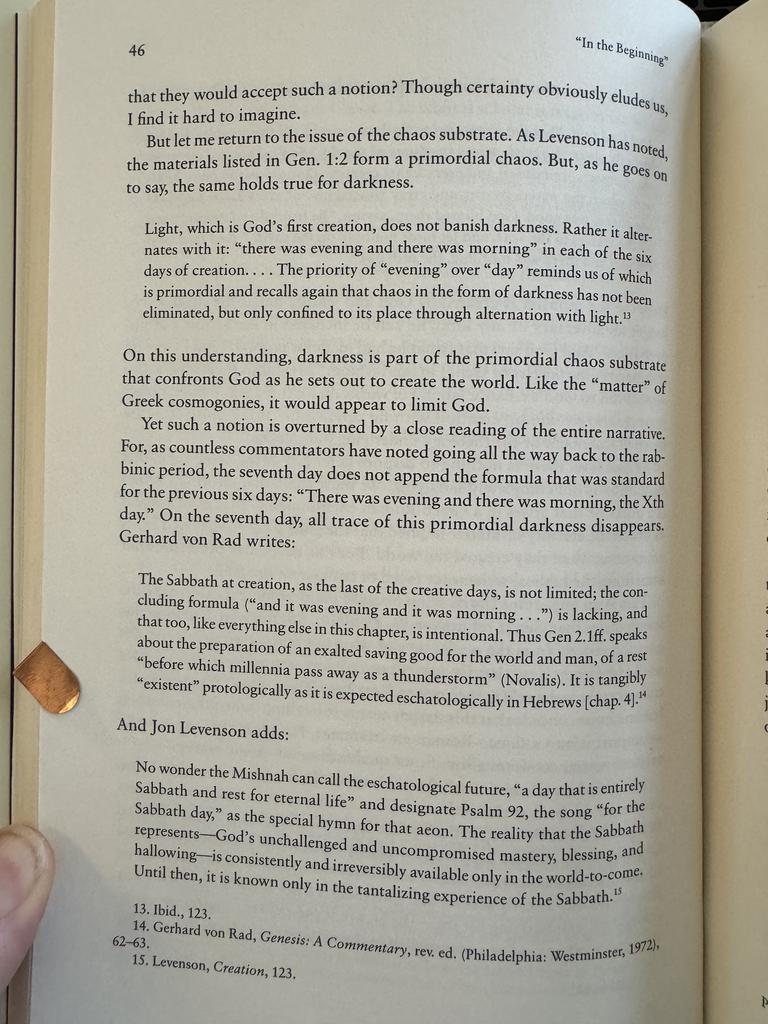
וְאָמַר רַב יְהוּדָה אָמַר רַב: עֲשָׂרָה דְּבָרִים נִבְרְאוּ בְּיוֹם רִאשׁוֹן, וְאֵלּוּ הֵן: שָׁמַיִם וָאָרֶץ, תֹּהוּ וָבֹהוּ, אוֹר וָחֹשֶׁךְ, רוּחַ וּמַיִם, מִדַּת יוֹם וּמִדַּת לַיְלָה.שָׁמַיִם וָאָרֶץ — דִּכְתִיב: ״בְּרֵאשִׁית בָּרָא אֱלֹהִים אֵת הַשָּׁמַיִם וְאֵת הָאָרֶץ״, תֹּהוּ וָבֹהוּ — דִּכְתִיב: ״וְהָאָרֶץ הָיְתָה תֹהוּ וָבֹהוּ״, אוֹר וָחֹשֶׁךְ, חֹשֶׁךְ — דִּכְתִיב: ״וְחֹשֶׁךְ עַל פְּנֵי תְהוֹם״, אוֹר — דִּכְתִיב: ״וַיֹּאמֶר אֱלֹהִים יְהִי אוֹר״, רוּחַ וּמַיִם — דִּכְתִיב: ״וְרוּחַ אֱלֹהִים מְרַחֶפֶת עַל פְּנֵי הַמָּיִם״, מִדַּת יוֹם וּמִדַּת לַיְלָה — דִּכְתִיב: ״וַיְהִי עֶרֶב וַיְהִי בֹקֶר יוֹם אֶחָד״.
The Gemara poses a question: Now that it is derived from the phrase “from one end of the heavens to the other,” why do I need the phrase “since the day that God created man upon the earth”?The Gemara answers that this phrase teaches us something else, according to Rabbi Elazar. As Rabbi Elazar said: The height of Adam the first man reached from the ground to the skies, as it is stated: “Since the day that God created man upon the earth, and from one end of the heavens” (Deuteronomy 4:32). When he sinned, the Holy One, Blessed be He, placed His hand upon him and diminished him, as it is stated: “You fashioned me behind and before, and laid Your hand upon me” (Psalms 139:5).Rav Yehuda said that Rav said: The size of Adam the first man was from one end of the world to the other, as it is stated: “Since the day that God created man upon the earth, and from one end of the heavens to the other,” which indicates that he spanned the entire length of the world. Once he sinned, the Holy One, Blessed be He, placed His hand upon him and diminished him, as it states: “And laid Your hand upon me.”The Gemara asks: If so, the two parts of the verse contradict each other, since one indicates that his height reached the heavens while the other says it reached the end of the earth. The Gemara answers: Both this and that are one, the same, measure.§ The Gemara continues to discuss Creation: Rav Yehuda said that Rav said: Ten things were created on the first day of Creation, and they are as follows: Heaven and earth; tohu and vohu, i.e., unformed and void; light and darkness; wind and water; the length of day and the length of night.All of these are derived from the Torah: Heaven and earth, as it is written: “In the beginning God created the heaven and the earth” (Genesis 1:1). Tohu and vohu, as it is written: “And the earth was unformed and void [tohu vavohu]” (Genesis 1:2). Light and darkness; darkness, as it is written: “And darkness was upon the face of the deep” (Genesis 1:2); light, as it is written: “And God said: Let there be light” (Genesis 1:3). Wind and water, as it is written: “And the wind of God hovered over the face of the waters” (Genesis 1:2). The length of day and the length of night, as it is written: “And there was evening, and there was morning, one day” (Genesis 1:5).It was taught in the Tosefta: Tohu is a green line that encompasses the entire world, and from which darkness emerges, as it is stated: “He made darkness His hiding place round about Him” (Psalms 18:12), indicating that a line of darkness surrounds the world. Vohu; these are damp stones submerged in the depths, from which water emerges, as it is stated: “And He shall stretch over it the line of tohu and stones of vohu” (Isaiah 34:11), which demonstrates that tohu is a line and that vohu is referring to stones.The Gemara poses a question: And was light created on the first day? But isn’t it written: “And God set them in the firmament of the heaven” (Genesis 1:17), and it is also written: “And there was evening, and there was morning, a fourth day” (Genesis 1:19), indicating that light was created on the fourth day.The Gemara answers: This should be understood in accordance with Rabbi Elazar, as Rabbi Elazar said: The light that the Holy One, Blessed be He, created on the first day was not that of the sun but a different kind of light, through which man could observe from one end of the world to the other. But when the Holy One, Blessed be He, looked upon the generation of the Flood and the generation of the Dispersion and saw that their ways were corrupt and that they might misuse this light for evil, He arose and concealed it from them, as it is stated: “And from the wicked their light is withheld” (Job 38:15).And for whom did He conceal it? For the righteous people in the future, as it is stated: “And God saw the light, that it was good” (Genesis 1:4), and “good” is referring to none other than the righteous, as it is stated: “Say of the righteous that it shall be good for them, for they shall eat the fruit of their actions” (Isaiah 3:10).When the light saw that it had been concealed for the righteous, it rejoiced, as it is stated: “The light for the righteous shall rejoice” (Proverbs 13:9).The Gemara comments: This is like a dispute between tanna’im: The light that the Holy One, Blessed be He, created on the first day was so profound that man could observe through it from one end of the world to the other; this is the statement of Rabbi Ya’akov. And the Rabbis say: This light is the very same as the lights created on the first day, but they were not suspended in their designated places in the firmament until the fourth day.§ Rav Zutra bar Tuvya said that Rav said: The world was created through ten attributes: Through wisdom, through understanding, through knowledge, through strength, through rebuke, through might, through righteousness, through justice, through kindness, and through mercy.Scriptural proof is provided for this statement as follows: It was created through wisdom and through understanding, as it is written: “The Lord founded earth with wisdom, and established the heavens with understanding” (Proverbs 3:19); through knowledge, as it is written: “With His knowledge the depths were broken up” (Proverbs 3:20); through strength and through might, as it is written: “Who by Your strength sets fast the mountains, who is girded about with might” (Psalms 65:7); through rebuke, as it is written: “The pillars of heaven tremble and are astonished at His rebuke” (Job 26:11); through righteousness and justice, as it is written: “Righteousness and justice are the foundation of Your throne” (Psalms 89:15); through kindness and mercy, as it is written: “Remember Your mercies, O Lord, and Your kindnesses, for they are from times of old” (Psalms 25:6).And Rav Yehuda said that Rav said, with regard to the same matter: When the Holy One, Blessed be He, created the world, it continued to expand like two balls of a warp, whose cord lengthens as they unravel, until the Holy One, Blessed be He, rebuked it and made it stand still, as it is stated: “The pillars of heaven tremble and are astonished at His rebuke” (Job 26:11). And this is the same as that which Reish Lakish said: What is the meaning of that which is written: “I am the Almighty God [El Shaddai]” (Genesis 17:1)? It means: I am He Who said to the world “enough [dai],” instructing it to stop expanding. Similarly, Reish Lakish said: When the Holy One, Blessed be He, created the sea, it continued to expand until the Holy One, Blessed be He, rebuked it and made it dry, as it is stated: “He rebukes the sea and makes it dry, and desiccates all the rivers” (Nahum 1:4).§ Beit Shammai and Beit Hillel dispute the order of Creation, as the Sages taught: Beit Shammai say: The heavens were created first and afterward the earth was created, as it is stated: “In the beginning God created the heaven and the earth” (Genesis 1:1), which indicates that heaven came first. And Beit Hillel say: The earth was created first, and heaven after it, as it is stated: “On the day that the Lord God made earth and heaven” (Genesis 2:4).Beit Hillel said to Beit Shammai: According to your words, does a person build a second floor and build the first floor of the house afterward? As it is stated: “It is He Who builds His upper chambers in the heaven, and has founded His vault upon the earth” (Amos 9:6), indicating that the upper floor, heaven, was built above the earth. Beit Shammai said to Beit Hillel: According to your words, does a person make a stool for his feet, and make a seat afterward? As it is stated: “So said the Lord: The heavens are My seat, and the earth My footstool” (Isaiah 66:1). But the Rabbis say: Both this and that were created as one, for it is stated: “Indeed, My hand has laid the foundation of the earth, and My right hand has spread out the heavens; when I call to them, they stand up together” (Isaiah 48:13), implying that they were created as one.The Gemara asks: And the others, Beit Shammai and Beit Hillel, what, in their opinion, is the meaning of “together”? The Gemara responds: It means that they do not separate from each other. In other words, the term “together” is referring not to the moment of their creation but to the manner of their positioning. The Gemara comments: In any case, the verses contradict each other, as heaven is sometimes mentioned first, while on other occasions earth is listed beforehand. Reish Lakish said: When they were created, He first created the heavens and afterward created the earth, but when He spread them out and fixed them in their places, He spread out the earth and afterward He spread out the heavens.Incidental to the above, the Gemara asks: What is the meaning and source of the word “heaven” [shamayim]? Rabbi Yosei bar Ḥanina said: It is an acronym, shesham mayim, meaning: That water is there. It was taught in a baraita:Shamayim means esh umayim, fire and water, which teaches that the Holy One, Blessed be He, brought them both and combined them together, and made the firmament from them.§ The Gemara relates: Rabbi Yishmael asked Rabbi Akiva a question when they were walking along the way. He said to him: You who served Naḥum of Gam Zu for twenty-two years, who would expound and learn that every appearance of the word et in the Torah is meant to teach something, what would he expound from the phrase: “The heaven and the earth” [et hashamayim ve’et ha’aretz] (Genesis 1:1)? He said to him: These words should be expounded as follows: Had it stated: In the beginning God created hashamayim veha’aretz, i.e., the heaven and the earth, without the word et, I would have said: Shamayim is the name of the Holy One, Blessed be He, and the same goes for aretz, and the verse would sound as if it meant that God, whose name is Shamayim and Aretz, created the world. Since it states “et hashamayim ve’et ha’aretz,” it is clear that these are created objects and that shamayim means the actual heaven and aretz is the actual earth. It is for this reason that the word et is necessary.
Nothing comes from nothing (Greek: οὐδὲν ἐξ οὐδενός; Latin: ex nihilo nihil fit) is a philosophical dictum first argued by Parmenides. It is associated with ancient Greekcosmology, such as is presented not just in the works of Homer and Hesiod, but also in virtually every internal system: there is no break in-between a world that did not exist and one that did, since it could not be created ex nihilo in the first place.
Aristotle[edit]
The ancient Greek philosopherAristotle argued that the world must have existed from eternity in his Physics as follows. In Book I, he argues that everything that comes into existence does so from a substratum. Therefore, if the underlying matter of the universe came into existence, it would come into existence from a substratum. But the nature of matter is precisely to be the substratum from which other things arise. Consequently, the underlying matter of the universe could have come into existence only from an already existing matter exactly like itself; to assume that the underlying matter of the universe came into existence would require assuming that an underlying matter already existed. As this assumption is self-contradictory, Aristotle argued, matter must be eternal.[1]
וכאשר בארתי ההקדמה הזאת, אומר, כי אלהינו יתברך ויתעלה הודיענו כי כל הדברים מחודשים, והוא חדשם לא מדבר כמו שאמר (בראשית א' א') בראשית ברא אלהים וגו'. ואומר עוד (ישעיהו מ״ד:כ״ד כ"ד) אנכי י"י עושה כל נוטה שמים לבדי וגומ'. ואמת זה אצלנו באותות ובמופתים וקבלנוהו. ואחרי כן עיינתי בענין הזה, היתאמת בעיון כאשר התאמת בנבואה? ומצאתיו כן מפנים רבים, אקצר מכללם ארבע ראיות:
דע כי אין בריחתנו מן המאמר בקדמות העולם מפני הכתובים אשר באו בתורה בהיות העולם מחודש – כי אין הכתובים המורים על חידוש העולם יותר מן הכתובים המורים על היות האלוה גשם; ולא שערי הפרוש סתומים בפנינו ולא נמנעים לנו בענין חידוש העולם, אבל היה אפשר לנו לפרשם כמו שעשינו בהרחקת הגשמות; ואולי זה היה יותר קל הרבה, והיינו יכולים יותר לפרש הפסוקים ההם ולהעמיד קדמות העולם, כמו שפרשנו הכתובים והרחקנו היותו ית׳ גשם. ואמנם, הביאונו שלא לעשות זה ושלא נאמינהו – שתי סיבות. האחת מהם – שהיות האלוה בלתי גוף התבאר במופת, ויתחיב בהכרח שיפורש כל מה שיחלוק על פשוטו המופת, ויודע שיש לו פרוש בהכרח; וקדמות העולם לא התבאר במופת ואין צריך שיודחו הכתובים ויפורשו מפני הכרעת דעת שאפשר להכריע סותרו בפנים מן ההכרעות; וזה – סיבה אחת. והסיבה השנית – כי האמיננו שהאלוה בלתי גשם לא יסתור לנו דבר מיסודי התורה ולא יכזיב מאמר כל נביא, ואין בו אלא מה שיחשבו הפתאים שבזה כנגד הכתוב – ואינו כנגדו כמו שבארנו אבל הוא כונת הכתוב! אבל אמונת הקדמות על הצד אשר יראה אותו אריסטו שהוא על צד החיוב ולא ישתנה טבע כלל ולא יצא דבר חוץ ממנהגו – הנה היא סותרת הדת מעיקרה ומכזבת לכל אות בהכרח ומבטלת כל מה שתיחל בו התורה או תפחיד ממנו – האלהים! אלא יפורשו האותות גם כן כמו שעשו בעלי התוך מן הישמעאלים ויצאו בזה למין מן ההזיה. אמנם אם יאמן הקדמות לפי הדעת השני אשר בארנונו – והוא דעת אפלטון – והוא שהשמים גם כן הוים נפסדים – הדעת ההוא לא יסתור יסודי התורה ולא תמשך אחריו הכזבת האותות, אבל העברתם, ואפשר שיפורשו הכתובים על פיו וימצאו לו דמיונות רבות בכתובתי ה׳תורה׳ וזולתם שאפשר להתלות בהם וגם יהיו לראיה. אבל אין ההכרח מביא אותנו לזה אלא אם התבאר הדעת ההוא במופת; אמנם כל עת שלא יתבאר במופת לא זה הדעת ניטה אליו, ולא הדעת ההוא גם כן נביט אליו כלל, אבל נבין הכתובים כפשוטיהם, ונאמר כי התורה הגידתנו ענין לא יגיע כוחנו להשגתו, והאות מעיד על אמיתת טענותינו.
WE do not reject the Eternity of the Universe, because certain passages in Scripture confirm the Creation; for such passages are not more numerous than those in which God is represented as a corporeal being; nor is it impossible or difficult to find for them a suitable interpretation. We might have explained them in the same manner as we did in respect to the Incorporeality of God. We should perhaps have had an easier task in showing that the Scriptural passages referred to are in harmony with the theory of the Eternity of the Universe if we accepted the latter, than we had in explaining the anthropomorphisms in the Bible when we rejected the idea that God is corporeal. For two reasons, however, we have not done so, and have not accepted the Eternity of the Universe. First, the Incorporeality of God has been demonstrated by proof: those passages in the Bible, which in their literal sense contain statements that can be refuted by proof, must and can be interpreted otherwise. But the Eternity of the Universe has not been proved; a mere argument in favour of a certain theory is not sufficient reason for rejecting the literal meaning of a Biblical text, and explaining it figuratively, when the opposite theory can be supported by an equally good argument.
Secondly, our belief in the Incorporeality of God is not contrary to any of the fundamental principles of our religion: it is not contrary to the words of any prophet. Only ignorant people believe that it is contrary to the teaching of Scripture: but we have shown that this is not the case: on the contrary, Scripture teaches the Incorporeality of God. If we were to accept the Eternity of the Universe as taught by Aristotle, that everything in the Universe is the result of fixed laws, that Nature does not change, and that there is nothing supernatural, we should necessarily be in opposition to the foundation of our religion, we should disbelieve all miracles and signs, and certainly reject all hopes and fears derived from Scripture, unless the miracles are also explained figuratively. The Allegorists amongst the Mohammedans have done this, and have thereby arrived at absurd conclusions. If, however, we accepted the Eternity of the Universe in accordance with the second of the theories which we have expounded above (ch. xxiii.), and assumed, with Plato, that the heavens are likewise transient, we should not be in opposition to the fundamental principles of our religion; this theory would not imply the rejection of miracles, but, on the contrary, would admit them as possible. The Scriptural text might have been explained accordingly, and many expressions might have been found in the Bible and in other writings that would confirm and support this theory. But there is no necessity for this expedient, so long as the theory has not been proved. As there is no proof sufficient to convince us, this theory need not be taken into consideration, nor the other one; we take the text of the Bible literally, and say that it teaches us a truth which we cannot prove; and the miracles are evidence for the correctness of our view.
Plato’s Timaeus
First published Tue Oct 25, 2005; substantive revision Fri May 13, 2022
In the Timaeus Plato presents an elaborately wrought account of the formation of the universe and an explanation of its impressive order and beauty. The universe, he proposes, is the product of rational, purposive, and beneficent agency. It is the handiwork of a divine Craftsman (“Demiurge,” dêmiourgos, 28a6) who, imitating an unchanging and eternal model, imposes mathematical order on a preexistent chaos to generate the ordered universe (kosmos). The governing explanatory principle of the account is teleological: the universe as a whole as well as its various parts are so arranged as to produce a vast array of good effects. For Plato this arrangement is not fortuitous, but the outcome of the deliberate intent of Intellect (nous), anthropomorphically represented by the figure of the Craftsman who plans and constructs a world that is as excellent as its nature permits it to be.
בְּרֵאשִׁ֖ית בָּרָ֣א אֱלֹהִ֑ים אֵ֥ת הַשָּׁמַ֖יִם וְאֵ֥ת הָאָֽרֶץ׃ וְהָאָ֗רֶץ הָיְתָ֥ה תֹ֙הוּ֙ וָבֹ֔הוּ וְחֹ֖שֶׁךְ עַל־פְּנֵ֣י תְה֑וֹם וְר֣וּחַ אֱלֹהִ֔ים מְרַחֶ֖פֶת עַל־פְּנֵ֥י הַמָּֽיִם׃ וַיֹּ֥אמֶר אֱלֹהִ֖ים יְהִ֣י א֑וֹר וַֽיְהִי־אֽוֹר׃ וַיַּ֧רְא אֱלֹהִ֛ים אֶת־הָא֖וֹר כִּי־ט֑וֹב וַיַּבְדֵּ֣ל אֱלֹהִ֔ים בֵּ֥ין הָא֖וֹר וּבֵ֥ין הַחֹֽשֶׁךְ׃ וַיִּקְרָ֨א אֱלֹהִ֤ים ׀ לָאוֹר֙ י֔וֹם וְלַחֹ֖שֶׁךְ קָ֣רָא לָ֑יְלָה וַֽיְהִי־עֶ֥רֶב וַֽיְהִי־בֹ֖קֶר י֥וֹם אֶחָֽד׃ {פ}
When God began to create heaven and earth— the earth being unformed and void, with darkness over the surface of the deep and a wind from God sweeping over the water— God said, “Let there be light”; and there was light. God saw that the light was good, and God separated the light from the darkness. God called the light Day and called the darkness Night. And there was evening and there was morning, a first day.
בראשית ברא אֵין הַמִּקְרָא הַזֶּה אוֹמֵר אֶלָּא דָּרְשֵׁנִי, כְּמוֹ שֶׁדְּרָשׁוּהוּ רַבּוֹתֵינוּ בִּשְׁבִיל הַתּוֹרָה שֶׁנִקְרֵאת רֵאשִׁית דַּרְכּוֹ (משלי ח'), וּבִשְׁבִיל יִשְׂרָאֵל שֶׁנִקְרְאוּ רֵאשִׁית תְּבוּאָתוֹ (ירמיה ב'); וְאִם בָּאתָ לְפָרְשׁוֹ כִּפְשׁוּטוֹ, כָּךְ פָּרְשֵׁהוּ בְּרֵאשִׁית בְּרִיאַת שָׁמַיִם וָאָרֶץ, וְהָאָרֶץ הָיְתָה תֹהוּ וָבֹהוּ וְחֹשֶׁךְ וַיֹּאמֶר אֱלֹהִים יְהִי אוֹר...
שֶׁאֵין לְךָ רֵאשִׁית בַּמִּקְרָא שֶׁאֵינוֹ דָבוּק לַתֵּבָה שֶׁלְּאַחֲרָיו, כְּמוֹ בְּרֵאשִׁית מַמְלֶכֶת יְהוֹיָקִים (שׁם כ"ז), רֵאשִׁית מַמְלַכְתּוֹ (בראשית י'), רֵאשִׁית דְּגָנְךָ (דברים י"ח, ד'), – אַף כָּאן אַתָּה אוֹמֵר בְּרֵאשִׁית בָּרָא אֱלֹהִים וְגוֹ', כְּמוֹ בְּרֵאשִׁית בְּרֹא; וְדוֹמֶה לוֹ תְּחִלַּת דִּבֶּר יהוה בְּהוֹשֵׁעַ (הושע א'), כְּלוֹמַר תְּחִלַת דִּבּוּרוֹ שֶׁל הַקָּבָּ"ה בְּהוֹשֵׁעַ
וְאִ"תֹּ לְהוֹרוֹת בָּא שֶׁאֵלּוּ תְּחִלָּה נִבְרְאוּ, וּפֵרוּשׁוֹ בְּרֵאשִׁית הַכֹּל בָּרָא אֵלוּ... אִ"כֵּ, תְּמַהּ עַל עַצְמְךָ, שֶׁהֲרֵי הַמַּיִם קָדְמוּ, שֶׁהֲרֵי כְתִיב וְרוּחַ אֱלֹהִים מְרַחֶפֶת עַל פְּנֵי הַמָּיִם, וְעַדַיִין לֹא גִלָּה הַמִּקְרָא, בְּרִיאַת הַמַּיִם מָתַי הָיְתָה, הָא לָמַדְתָּ, שֶׁקָּדְמוּ הַמַּיִם לָאָרֶץ, וְעוֹד, שֶׁהַשָּׁמַיִם מֵאֵשׁ וּמַיִם נִבְרְאוּ, עַל כָּרְחֲךָ לֹא לִמֵּד הַמִּקְרָא סֵדֶר הַמֻּקְדָמִים וְהַמְאֻחָרִים כְּלוּם:
בראשית ברא IN THE BEGINNING GOD CREATED — This verse calls aloud for explanation in the manner that our Rabbis explained it: God created the world for the sake of the Torah which is called (Proverbs 8:22) “The beginning (ראשית) of His (God’s) way”, and for the sake of Israel who are called (Jeremiah 2:3) “The beginning (ראשית) of His (God’s) increase’’. If, however, you wish to explain it in its plain sense, explain it thus: At the beginning of the Creation of heaven and earth when the earth was without form and void and there was darkness, God said, “Let there be light”. The text does not intend to point out the order of the acts of Creation — to state that these (heaven and earth) were created first; for if it intended to point this out, it should have written 'בראשונה ברא את השמים וגו “At first God created etc.” And for this reason: Because, wherever the word ראשית occurs in Scripture, it is in the construct state. E. g., (Jeremiah 26:1) “In the beginning of (בראשית) the reign of Jehoiakim”; (Genesis 10:10) “The beginning of (ראשית) his kingdom”; (Deuteronomy 18:4) “The first fruit of (ראשית) thy corn.” Similarly here you must translate בראשית ברא אלהים as though it read בראשית ברוא, at the beginning of God’s creating. A similar grammatical construction (of a noun in construct followed by a verb) is: (Hosea 1:2) תחלת דבר יהוה בהושע, which is as much as to say, “At the beginning of God’s speaking through Hosea, the Lord said to Hosea.” Should you, however, insist that it does actually intend to point out that these (heaven and earth) were created first, and that the meaning is, “At the beginning of everything He created these, admitting therefore that the word בראשית is in the construct state and explaining the omission of a word signifying “everything” by saying that you have texts which are elliptical, omitting a word, as for example (Job 3:10) “Because it shut not up the doors of my mother’s womb” where it does not explicitly explain who it was that closed the womb; and (Isaiah 8:4) “He shall take away the spoil of Samaria” without explaining who shall take it away; and (Amos 6:12) “Doth he plough with oxen," and it does not explicitly state, “Doth a man plough with oxen”; (Isaiah 46:10) “Declaring from the beginning the end,” and it does not explicitly state, “Declaring from the beginning of a thing the end of a thing’ — if it is so (that you assert that this verse intends to point out that heaven and earth were created first), you should be astonished at yourself, because as a matter of fact the waters were created before heaven and earth, for, lo, it is written, (v. 2) “The Spirit of God was hovering on the face of the waters,” and Scripture had not yet disclosed when the creation of the waters took place — consequently you must learn from this that the creation of the waters preceded that of the earth. And a further proof that the heavens and earth were not the first thing created is that the heavens were created from fire (אש) and water (מים), from which it follows that fire and water were in existence before the heavens. Therefore you must admit that the text teaches nothing about the earlier or later sequence of the acts of Creation.
ברא. רובי ממפרשים אמרו שהבריאה להוציא יש מאין וכן אם בריאה יברא יהוה. והנה שכחו ויברא אלהים את התנינים ושלש בפסוק אחד ויברא אלהים את האדם. וברא חשך שהוא הפך האור שהוא יש וזה דקדוק המלה ברא לשני טעמים זה האחד והשני לא ברה אתם לחם. וזה השני ה"א תחת אלף כי כמוהו להברות את דוד כי הוא מהבנין הכבד הנוסף ואם היה באל"ף היה כמו להבריאכם... וטעמו לגזור ולשום גבול נגזר והמשכיל יבין:
CREATED. Most Biblical commentators explain that the word bara (created) indicates creation ex nihilo. But if the Lord make (yivra) a new thing (beri’ah) (Num. 16:30) is similar. However, they have overlooked And God created (va-yivra) the great sea monsters (Gen. 1:21) and the three times the word created is used in one verse, viz., And God created (va-yivra) man in His own image, in the image of God created (bara) He him; male and female created (bara) He them (Gen. 1:27). They also failed to consider I form the light, and create darkness (Is. 45:7) wherein darkness, which is the opposite of light, an existing entity, is described by the prophet as being created. The following is the precise explanation of the word bara. Bara has two meanings, one of which has been noted above. The second is found in the verse neither did he eat (bara) bread with them (II Samuel 12:17). However, in the latter case, an alef has been substituted for a heh. The reason is that bara (in I Sam. 12:17) is similar to le-havrot (to urge to eat) in And all the people came to cause David to eat (le-havrot) bread (II Sam. 3:35). The verb le-havrot appears in the hifil (and its root ends with heh), for if it ended with an alef, Scripture would have read le-havri, as in to make yourselves fat (le-havri’achem) with the chiefest of all the offerings of Israel (I Sam. 2:29). We also find bara conjugated in the pi’el, as in and cut down (u-vereta) for thyself (trees) (Joshua 17:15). This is not like the similar word beru in choose (beru) you a man for you (I Sam. 17:8) but rather like bare (hack, dispatch) in and dispatch them (u-vare) with their swords (Ezekiel 23:47). The meaning of bara is to cut or to set a boundary. The intelligent person will understand what I am alluding to.
כל המפרשים האמתיים הסכימו בפירוש אלו הכתובים, שכונתם לומר כי בראשית הבריאה נברא חומר משותף לכל מה שתחת גלגל הירח. ואם קצתם סברו שהכונה באמרו את השמים ואת הארץ וכו' שהיו שני חומרים נבדלים שהם חומר השמים וחומר הארץ, כלם הסכימו שזה הפסוק השני כולל ארבעה יסודות שהם אבות לכל מה שתחת גלגל הירח, והם האש הנרמז במלת וחשך, והאור הנרמז במלת ורוח אלהים, והמים והעפר הנכללים במלת תהום, ואמנם חייבה החכמה האלהית להיות חומר אחד משותף לכל מה שתחת גלגל הירח, להיות הרצון מאתו להמשיך טבע ההויה כפי האפשרות לא רצה לברוא דברים רבים יש מאין אחר שיש באפשרות חומר אחד לכלול כלם...
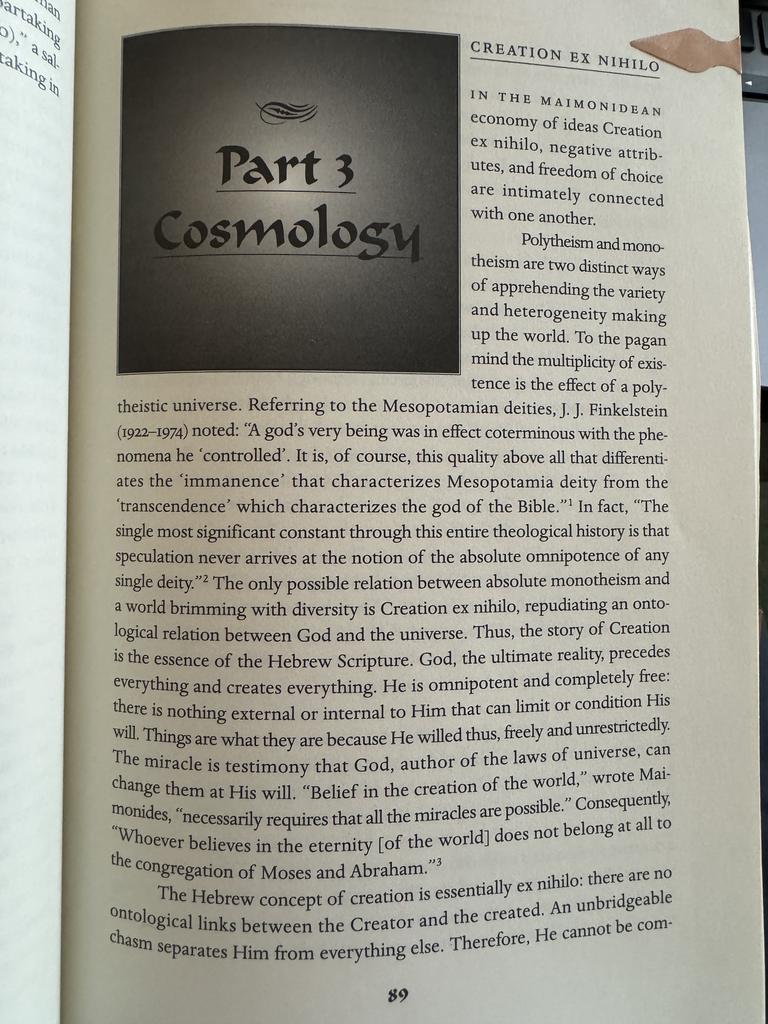
All of the true expositors are in agreement that the intent of these verses is that in the beginning of the creation there was created a common substance for all that is beneath the lunar orb. And though some of them hold that the intent of eth hashamayim ve'eth ha'aretz is that there were two distinct substances, that of heaven and that of earth, they are all in agreement that the second verse includes the four elements which give rise to all that is found beneath the lunar orb, namely: fire (intimated in the word "darkness"), air (intimated in the expression "the spirit of G-d"), and water and earth (subsumed in the word "deep"). Indeed, the Divine Wisdom mandated one common substance for all that is found beneath the lunar orb, willing the nature of existence to proceed from the possibilities implicit in its origin. It did not wish to create many things creatio ex nihilo, it being within the nature of one substance to include all. Therefore, if we must posit the substance of heaven as distinct from that of earth, it is because the heavenly form could not be generated by the earthly substance. But since all that is found from the lunar orb downwards could conceivably result from this substance, then the creation of two substances in the nether world would constitute needless creatio ex nihilo, and this miraculous, ineluctable act of creatio ex nihilo [of one common substance] suffice. It is further to be noted that the entire terrestrial creation is intended for the fulfillment of man's needs, the greatest of which is the sustenance that he derives therefrom, so that the substance of man is closely allied to what is derived from the other terrestrial composites, vegetable or animal, and is subsequently converted through his natural processes into the very substance of his body. And this is possible only by virtue of the common substance that they share, in the absence of which all this could not take place. The sages are in agreement that a simple element cannot be assimilated into a compound, though it form a part of that compound, such union being negated by the very antagonism between simple and compound: how much less conceivable is it, then, that such union could be effected between two entirely dissimilar substances. If the other terrestrial creations, then, were of a different substance from man, they would be both unassimilable with him and unfit for him. It is for this reason that everything created in common with man, namely, the terrestrial world as a whole, partakes of one substance. But the celestial world's being of a different substance is not in opposition to man in this regard, for it has nothing in common with him in point of his substance, but only in point of his form, and form undergoes no transformation.
והחכמה מאי"ן תמצא, פי' מכח עליון שאינו מושג מהותו משם היא נמצאת והיא מציאות י"ש מאי"ן. אמנם אין זה העדר גמור כי לא יתהוה איזה דבר שיזדמן מאי זה דבר שיזדמן כל שכן שלא יתהוה יש מאין אבל נקרא אין לפי שאינו מושג לא מצד עילתו ולא מצד עצמו שעילתו הוא עילת העילות ונקרא האי"ן קדמון לפי שקדם לעולם ואין זה דבר גשמי.
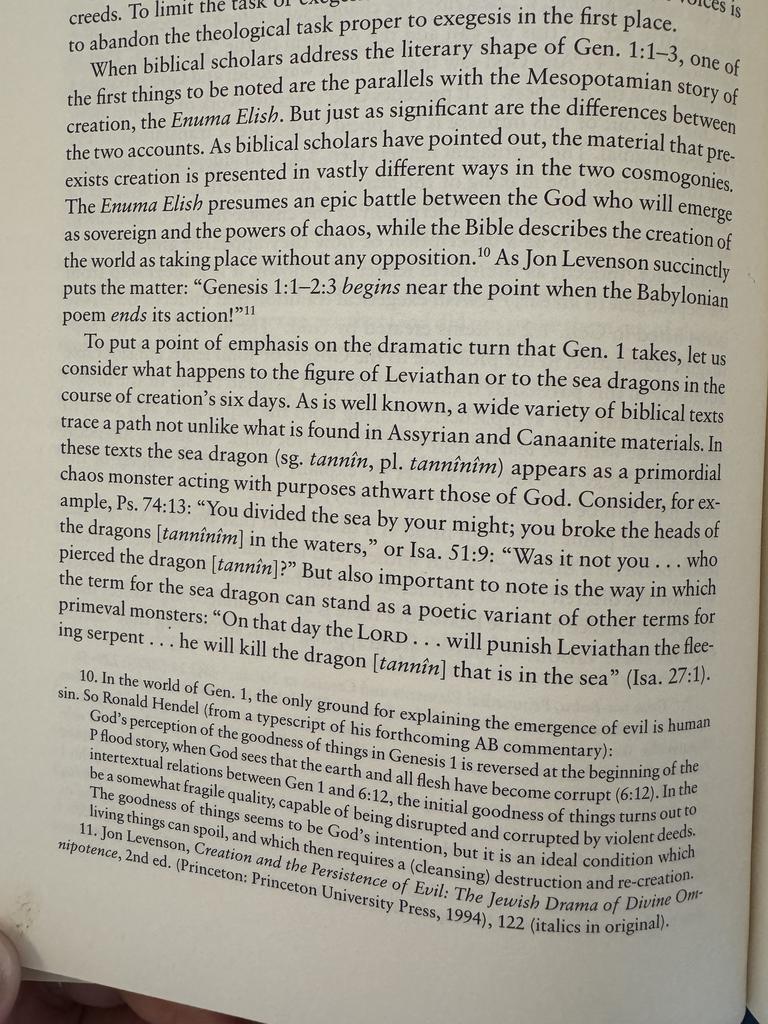
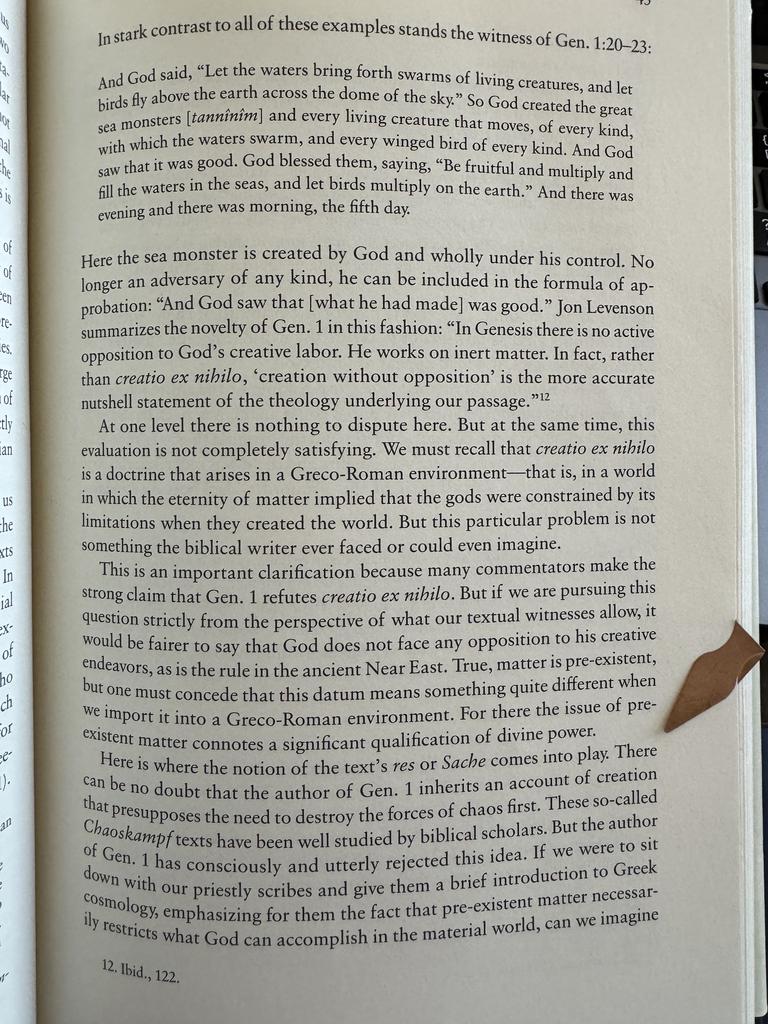
Enuma Elish
All of the tablets containing the myth (also known as Enuma Elis), found at Ashur, Kish, Ashurbanipal's library at Nineveh, Sultantepe, and other excavated sites, date to c. 1200 BCE. Their colophons, however, indicate that these are all copies of a much older version of the myth dating from long before the reign of Hammurabi of Babylon (1792-1750 BCE)
The story, one of the oldest in the world, concerns the birth of the gods and the creation of the universe and human beings. In the beginning, there was only undifferentiated water swirling in chaos. Out of this swirl, the waters divided into sweet, fresh water, known as the god Apsu, and salty bitter water, the goddess Tiamat. Once differentiated, the union of these two entities gave birth to the younger gods.
These young gods, however, were extremely loud, troubling the sleep of Apsu at night and distracting him from his work by day. Upon the advice of his Vizier, Mummu, Apsu decides to kill the younger gods. Tiamat, hearing of their plan, warns her eldest son, Enki (sometimes Ea) and he puts Apsu to sleep and kills him. From Apsu's remains, Enki creates his home.
Tiamat, once the supporter of the younger gods, now is enraged that they have killed her mate. She consults with the god Quingu who advises her to make war on the younger gods. Tiamat rewards Quingu with the Tablets of Destiny, which legitimize the rule of a god and control the fates, and he wears them proudly as a breastplate. With Quingu as her champion, Tiamat summons the forces of chaos and creates eleven horrible monsters to destroy her children.
Ea, Enki, and the younger gods fight against Tiamat futilely until, from among them, emerges the champion Marduk who swears he will defeat Tiamat. Marduk defeats Quingu and kills Tiamat by shooting her with an arrow which splits her in two; from her eyes flow the waters of the Tigris and Euphrates Rivers. Out of Tiamat's corpse, Marduk creates the heavens and the earth, he appoints gods to various duties and binds Tiamat's eleven creatures to his feet as trophies (to much adulation from the other gods) before setting their images in his new home. He also takes the Tablets of Destiny from Quingu, thus legitimizing his reign.
After the gods have finished praising him for his great victory and the art of his creation, Marduk consults with the god Ea (the god of wisdom) and decides to create human beings from the remains of whichever of the gods encouraged Tiamat to make war. Quingu is charged as guilty and killed and, from his blood, Ea creates Lullu, the first man, to be a helper to the gods in their eternal task of maintaining order and keeping chaos at bay...
Anderson
Halbertal - Maimonides: Life and Thought 2015

Aristotle Metaphysics Book XII
But even if we are to suppose that there is something which is kinetic and productive although it does not actually move or produce, there will not necessarily be motion; for that which has a potentiality may not actualize it.Thus it will not help matters if we posit eternal substances, as do the exponents of the Forms, unless there is in them some principle which can cause change.35 And even this is not enough, nor is it enough if there is another substance besides the Forms; for unless it actually functions there will not be motion.And it will still not be enough even if it does function, if its essence is potentiality; for there will not be eternal motion, since that which exists potentially may not exist. [20] Therefore there must be a principle of this kind whose essence is actuality. Furthermore these substances36 must be immaterial; for they must be eternal if anything is. Therefore they are actuality.
There is a difficulty, however; for it seems that everything which actually functions has a potentiality, whereas not everything which has a potentiality actually functions; so that potentiality is prior. But if this is so, there need be no reality; for everything may be capable of existing, but not yet existent.Yet if we accept the statements of the cosmologists who generate everything from Night,37 or the doctrine of the physicists that "all things were together,"38 we have the same impossibility; for how can there be motion if there is no actual cause? Wood will not move itself—carpentry must act upon it; nor will the menses or the earth move themselves—the seeds must act upon the earth, and the semen on the menses. Hence some, e.g. Leucippus39 and Plato,40 posit an eternal actuality, for they say that there is always motion; but why there is, and what it is, they do not say; nor, if it moves in this or that particular way, what the cause is. For nothing is moved at haphazard, but in every case there must be some reason present; as in point of fact things are moved in one way by nature, and in another by force or mind or some other agent. And further, what kind of motion is primary? For this is an extremely important point. [1072a] [1] Again, Plato at least cannot even explain what it is that he sometimes thinks to be the source of motion, i.e., that which moves itself; for according to him the soul is posterior to motion and coeval with the sensible universe.41 Now to suppose that potentiality is prior to actuality is in one sense right and in another wrong; we have explained42 the distinction. But that actuality is prior is testified by Anaxagoras (since mind is actuality), and by Empedocles with his theory of Love and Strife, and by those who hold that motion is eternal, e.g. Leucippus.
Therefore Chaos or Night did not endure for an unlimited time, but the same things have always existed, either passing through a cycle or in accordance with some other principle—that is, if actuality is prior to potentiality.Now if there is a regular cycle, there must be something43 which remains always active in the same way; but if there is to be generation and destruction, there must be something else44 which is always active in two different ways. Therefore this must be active in one way independently, and in the other in virtue of something else, i.e. either of some third active principle or of the first.It must, then, be in virtue of the first; for this is in turn the cause both of the third and of the second. Therefore the first is preferable, since it was the cause of perpetual regular motion, and something else was the cause of variety; and obviously both together make up the cause of perpetual variety. Now this is just what actually characterizes motions; therefore why need we seek any further principles?
Since (a) this is a possible explanation, and (b) if it is not true, we shall have to regard everything as coming from "Night"45 and "all things together" and "not-being,"46 [20] these difficulties may be considered to be solved. There is something which is eternally moved with an unceasing motion, and that circular motion. This is evident not merely in theory, but in fact. Therefore the "ultimate heaven" must be eternal. Then there is also something which moves it.And since that which is moved while it moves is intermediate, there is something which moves without being moved; something eternal which is both substance and actuality.
…
It is evident that there is only one heaven.77 For if there is to be a plurality of heavens (as there is of men), the principle of each must be one in kind but many in number.But all things which are many in number have matter (for one and the same definition applies to many individuals, e.g. that of "man"; but Socrates is one78), but the primary essence has no matter, because it is complete reality. Therefore the prime mover, which is immovable, is one both in formula and in number; and therefore so also is that which is eternally and continuously in motion. Therefore there is only one heaven. [1074b] [1]
…
The rule of many is not good; let one be the ruler.107