


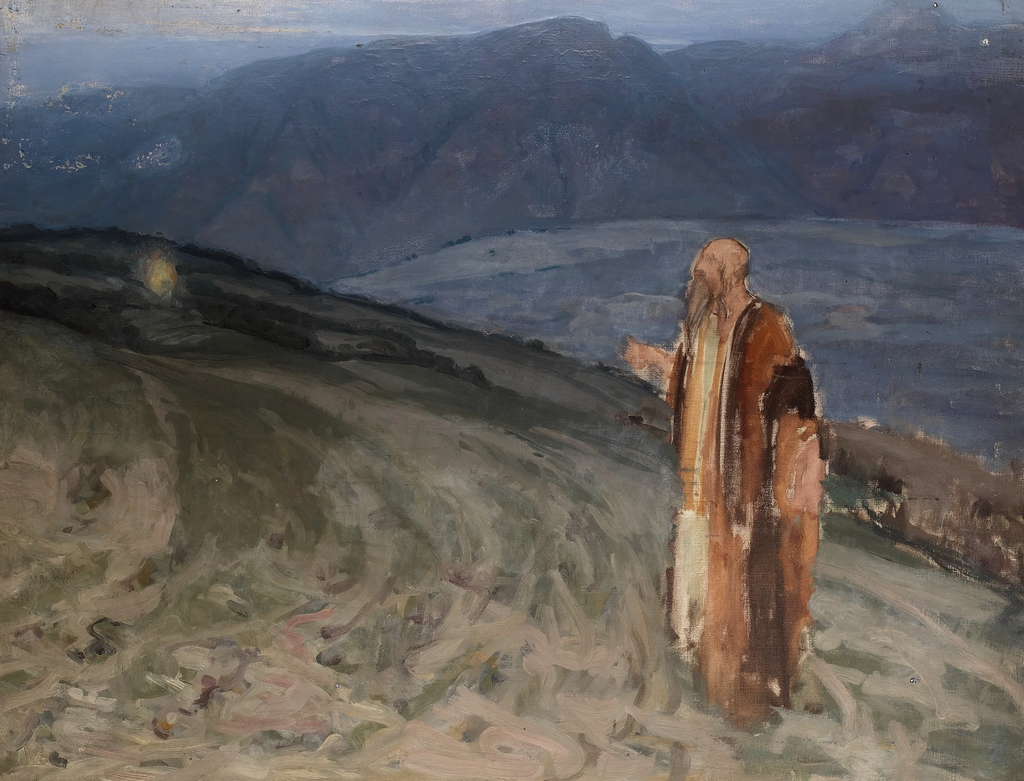
Study for Moses and the Burning Bush, 1896 Henry Ossawa Tanner (1859-1937)
(African American painter who worked primarily in France)
(א) וּמֹשֶׁ֗ה הָיָ֥ה רֹעֶ֛ה אֶת־צֹ֛אן יִתְר֥וֹ חֹתְנ֖וֹ כֹּהֵ֣ן מִדְיָ֑ן וַיִּנְהַ֤ג אֶת־הַצֹּאן֙ אַחַ֣ר הַמִּדְבָּ֔ר וַיָּבֹ֛א אֶל־הַ֥ר הָאֱלֹקִ֖ים חֹרֵֽבָה׃ (ב) וַ֠יֵּרָ֠א מַלְאַ֨ךְ ה׳ אֵלָ֛יו בְּלַבַּת־אֵ֖שׁ מִתּ֣וֹךְ הַסְּנֶ֑ה וַיַּ֗רְא וְהִנֵּ֤ה הַסְּנֶה֙ בֹּעֵ֣ר בָּאֵ֔שׁ וְהַסְּנֶ֖ה אֵינֶ֥נּוּ אֻכָּֽל׃ (ג) וַיֹּ֣אמֶר מֹשֶׁ֔ה אָסֻֽרָה־נָּ֣א וְאֶרְאֶ֔ה אֶת־הַמַּרְאֶ֥ה הַגָּדֹ֖ל הַזֶּ֑ה מַדּ֖וּעַ לֹא־יִבְעַ֥ר הַסְּנֶֽה׃ (ד) וַיַּ֥רְא ה׳ כִּ֣י סָ֣ר לִרְא֑וֹת וַיִּקְרָא֩ אֵלָ֨יו אֱלֹקִ֜ים מִתּ֣וֹךְ הַסְּנֶ֗ה וַיֹּ֛אמֶר מֹשֶׁ֥ה מֹשֶׁ֖ה וַיֹּ֥אמֶר הִנֵּֽנִי׃ (ה) וַיֹּ֖אמֶר אַל־תִּקְרַ֣ב הֲלֹ֑ם שַׁל־נְעָלֶ֙יךָ֙ מֵעַ֣ל רַגְלֶ֔יךָ כִּ֣י הַמָּק֗וֹם אֲשֶׁ֤ר אַתָּה֙ עוֹמֵ֣ד עָלָ֔יו אַדְמַת־קֹ֖דֶשׁ הֽוּא׃ (ו) וַיֹּ֗אמֶר אָנֹכִי֙ אֱלֹקֵ֣י אָבִ֔יךָ אֱלֹקֵ֧י אַבְרָהָ֛ם אֱלֹקֵ֥י יִצְחָ֖ק וֵאלֹקֵ֣י יַעֲקֹ֑ב וַיַּסְתֵּ֤ר מֹשֶׁה֙ פָּנָ֔יו כִּ֣י יָרֵ֔א מֵהַבִּ֖יט אֶל־הָאֱלֹקִֽים׃
(1) Now Moses, tending the flock of his father-in-law Jethro, the priest of Midian, drove the flock into the wilderness, and came to Horeb, the mountain of God. (2) A messenger of ה׳ appeared to him in a blazing fire out of a bush. He gazed, and there was a bush all aflame, yet the bush was not consumed. (3) Moses said, “I must turn aside to look at this marvelous sight; why doesn’t the bush burn up?” (4) When ה׳ saw that he had turned aside to look, God called to him out of the bush: “Moses! Moses!” He answered, “Here I am.” (5) And [God] said, “Do not come closer! Remove your sandals from your feet, for the place on which you stand is holy ground!” (6) and continued, “I am the God of your father’s [house]—the God of Abraham, the God of Isaac, and the God of Jacob.” And Moses hid his face, for he was afraid to look at God.
There are so many moments in life when we don’t see what’s right in front of us. We could be in a crisis, in a moment of despair; or we could be plodding along, putting one foot in front of the other, seemingly going about our “normal” life without a second thought. We could be walking down the street, eyes fixed on our cell phones, not seeing the beauty or the tragedy around us. We could be scrolling through virtual space, focusing on objects or products to fulfill our own needs, without widening our gaze to the needs of others. We could be in the narrow place of tunnel vision, our capacity to perceive constricted by habit, routine, and trauma.
How often does it happen that we walk right past a miracle “hiding in plain sight”, something that - were we to turn and look - could change our lives, could change the way we view and experience the world, could change our life path and what we share with the world?
We are living in difficult and traumatizing times. As I write this, seemingly unstoppable wildfires are raging in Los Angeles, as they have in many parts of the world in the last few years. Wars are raging on many continents. The plagues of poverty and homelessness are more pervasive in our country than ever. Rhetoric in the media and public square is often cruel, clearly biased, and unkind.
When humans feel unsafe, or threatened, or have been traumatized, it’s well known that one of three deep-inside-of-us responses arise: fight, flight, or freeze. Most of us have experienced this instantaneous trauma responses, at least momentarily; for some people, the immediate threat of danger and trauma is experienced as continuous.
When we are in a moment of a fear response, our vision is constricted; sometimes this is called “tunnel vision”. Doubtless we’ve all had the experience. In moments of fear, our field of vision narrows, so that it can seem as if all that we see is directly in front of us; elements on the periphery of our visual field are not seen.
As a psychiatrist and a psychoanalyst and a homeopath, I am all too familiar with the ways that trauma affects us; and I understand that the constriction of our visual field occurs on a mental level as well, occurs in our “interior landscape”. When we have been traumatized, we can become stuck in thought patterns such that we expect to be repeatedly traumatized, or can only imagine possible outcomes that are dangerous or disadvantageous to us.
Over the past decade I have observed, and experienced, an increasing intransigence in many domains of public discourse; and I have also observed, and experienced within myself, a tendency within individuals and communities to narrow our vision, to only see things “our way” with an ever-decreasing likelihood that we will be able to dispassionately see things from someone else’s viewpoint. In other words, as fear and trauma increase, our capacity for open-mindedness, kindness, and empathy seem to decrease. And our ability to perceive a new idea, a new possibility, also decreases.
When we’re walking through the world in fear, it’s very difficult to see anything new. There are many approaches and techniques for soothing and calming ourselves in situations of threat, so that we can have “soft eyes” so that we have access to our full visual fields. Meditation, prayer, exercise, being in nature, regulating one’s breathing, yoga, qi gong, consulting with a physician or other healing professional; there are many approaches we can take to calm ourselves and broaden our field of vision, both inside ourselves and in the outside world, to emerge from the dark tunnel of trauma.
Moses is a traumatized person who is a member of a traumatized group; a community of immigrants whose lives had been made extremely difficult by the rulers of their temporary home. He was separated from his family of origin in infancy, in an atmosphere of violence, and raised in an alien - albeit privileged - environment. Coming of age, he “saw” the injustices that his people were suffering, and also were enacting upon one another; and in that “seeing” and his impulse toward justice, he killed someone, then fled for his life. He found a new home, in circumstances that surely were vastly reduced from the privileged aristocratic setting of his adopted home. He married, and had children; and this former adopted son of Pharaoh’s daughter is now tending the flocks of his father in law in the desert.
This is his situation at the moment of his encounter with the Burning Bush. He seems to be doing his "usual/ customary thing" immediately prior to seeing the Burning Bush: the verb used in Exodus 3:1 for "leading" the flock - וַיִּנְהַ֤ג - is from the verbal root √נהג, which is connected to the word מנהג (minhag) - custom. If Moses had grazed his father-in-law's flocks in the wilderness on numerous occasions, what were the conditions on this particular day that made it possible for Moses to encounter the Burning Bush? Indeed, what can we learn from this part of Parashat Shemot, to cultivate in ourselves, so that we might be more apt to turn aside to a light that is shining for us?
The verse then says, וַיָּבֹ֛א אֶל־הַ֥ר הָאֱלֹקִ֖ים חֹרֵֽבָה - he came to the Mountain of God - har ha-elohim horeb. Was this an unusual element of Moses' path that day (coming to the mountain of God)? Perhaps this was the novel element that set the stage for the appearance of the messenger from God - the theophanic angel - in the burning bush. Do we need to go to a different place to have a different sort of encounter, to broaden our tunnel vision?
Sforno suggests that Moses wished to pray and meditate in this place "in complete isolation and concentration" - in other words, that Moses was in an intentional state of mind, that would invite a numinous experience:
ויבא אל הר האלקים חורבה. הוא לבדו להתבודד ולהתפלל...
ויבא אל הר האלוקים חורבה. Moses, all by himself; he wanted to pray and meditate there in complete isolation and concentration....
A theophany (from Ancient GreeK θεοφάνεια theopháneia, 'appearance of a deity' theos, meaning "god", phainein, meaning "to show or to appear") is an encounter with the Divine that manifests in an observable form.
And by analogy, attempting to learn from these verses about how we can each cultivate an attitude that would increasingly allow for encounters with the Divine: what are these particular conditions for us?
Here, we encounter a challenging paradox for the aniconism of Judaism: since we are taught that God isn’t visible and we are not to make representations of God, then how can we see God? The Second Commandment:
A theophany (from Ancient GreeK θεοφάνεια theopháneia, 'appearance of a deity' theos, meaning "god", phainein, meaning "to show or to appear") is an encounter with the Divine that manifests in an observable form.
And by analogy, attempting to learn from these verses about how we can each cultivate an attitude that would increasingly allow for encounters with the Divine: what are these particular conditions for us?
Here, we encounter a challenging paradox for the aniconism of Judaism: since we are taught that God isn’t visible and we are not to make representations of God, then how can we see God? The Second Commandment:
(ד) לֹֽ֣א־תַֽעֲשֶׂ֨ה־לְךָ֥֣ פֶ֣֙סֶל֙ ׀ וְכׇל־תְּמוּנָ֔֡ה אֲשֶׁ֤֣ר בַּשָּׁמַ֣֙יִם֙ ׀ מִמַּ֔֡עַל וַֽאֲשֶׁ֥ר֩ בָּאָ֖֨רֶץ מִתָּ֑͏ַ֜חַת וַאֲשֶׁ֥ר בַּמַּ֖֣יִם ׀ מִתַּ֥֣חַת לָאָֽ֗רֶץ׃
(4) You shall not make for yourself a sculptured image, or any likeness of what is in the heavens above, or on the earth below, or in the waters under the earth.
Perhaps we can become aware of the presence of the Divine Source by encountering a messenger. If we do become aware of this presence, what would our reaction be? Do we turn away, continuing on our "normal" path, or do we turn toward?
Angels - messengers of God - can help us out here. (Remember that the Biblical Hebrew word for "angel" - מַלְאָך - can also mean "messenger".) A theophanic angel is a phenomenon who / which, when it arrives, announces the presence of God through its own presence.
Moments of theophany often include the following elements:
-
The experience feels numinous
-
This sort of experience often occurs in solitude
-
The person experiencing a numinous theophanic moment may react in a binary sort of way - "this can't be happening / I am scared or disbelieving" alternating with "I am drawn to this experience, and would like to enter more deeply into it.
For a deeper dive into theophanic moments in Tanakh, I recommend scholar George Savran’s 2003 article “Theophany As Type Scene".
https://www.academia.edu/90040477/Theophany_as_Type_Scene?uc-sb-sw=53948318
Dr. Savran highlights the solitary nature of theophanic experiences, which suggest “that there is something about the appearance of the divine that is antithetical to human company. This is a highly private experience, even though it always has public ramifications. This solitude also increases the sense of mystery and sanctity surrounding the encounter. Insofar as it is a highly uncommon occurrence, the recipient of the experience must separate himself from his everyday reality as a precondition for the encounter.” (p. 127)
Perhaps it is this solitary aspect of encountering the Divine that explains the desert setting of Moses' encounter with the messenger of God at the Burning Bush. Horeb means dry or desert - a desolate and vast landscape. In my mind's eye - as in Ossawa Turner's evocative 1896 painting - I see a distant and novel visual element in a vast and monotonous vista.
In our daily contemporary lives we regularly are presented with such landscapes: whether it be the now vast and increasing desolation resulting from the wildfires currently raging in the Los Angeles area, or the monotonous and shocking cityscapes of unsheltered homeless humans in my city [San Francisco] or in yours; or the shocking results of poverty and injustice throughout our world; or the devastating destruction in kibbutzim on October 7, 2023; or the incomprehensible destruction of structures, and infrastructures, and entire families, in Gaza; or.... whichever desolation comes to mind for you, and troubles you the most.
What is the receptive apparatus that we - as potential experiencers of theophany - need to have inside of us, in order for the encounter to occur? What are our individual characteristics that can help us be open to the presence of the angel, to be capable of seeing or hearing, to be willing to turn aside and move toward the encounter?
What draws Moses to "turn aside"? How does he feel as he approaches the “great sight”? Are there ways that each of us can experience this too?
“Moses at the bush does not err in his initial reaction to it so much as reveal his limited understanding of what he sees. Indeed, this limited perception is an essential element in the refocusing of the protagonist's understanding, which is common to theophany narratives. It often reflects the essential shift in the individual's percep- tion of reality when confronted with a manifestation of the divine. Not only is the protagonist's grasp of the situation partial, but the narrator's general reluctance to describe divine manifestations in anything but general terms adds to this sense of incompleteness and points to its being a stage in the character's progression toward a new level of knowledge.” (Savran, p. 123)
Perhaps we can become aware of the presence of the Divine Source by encountering a messenger. If we do become aware of this presence, what would our reaction be? Do we turn away, continuing on our "normal" path, or do we turn toward?
Angels - messengers of God - can help us out here. (Remember that the Biblical Hebrew word for "angel" - מַלְאָך = can also mean "messenger".) A theophanic angel is a phenomenon who / which, when it arrives, announces the presence of God through its own presence.
Moments of theophany often include the following elements:
- The experience feels numinous
- This sort of experience often occurs in solitude
- The person experiencing a numinous theophanic moment may react in a binary sort of way - "this can't be happening / I am scared or disbelieving" alternating with "I am drawn to this experience, and would like to enter more deeply into it.
For a deeper dive into theophanic moments in Tanakh, I recommend scholar George Savran 2003 article “Theophany As Type Scene"
https://www.academia.edu/90040477/Theophany_as_Type_Scene?uc-sb-sw=53948318
Dr. Savran highlights the solitary nature of theophanic experiences, which suggest “that there is something about the appearance of the divine that is antithetical to human company. This is a highly private experience, even though it always has public ramifications. This solitude also increases the sense of mystery and sanctity surrounding the encounter. Insofar as it is a highly uncommon occurrence, the recipient of the experience must separate himself from his everyday reality as a precondition for the encounter.” (p. 127)
Perhaps it is this solitary aspect of encountering the Divine that explains the desert setting of Moses' encounter with the messenger of God at the Burning Bush. Horeb means dry or desert - a desolate and vast landscape. In my mind's eye - as in Ossawa Turner's evocative 1896 painting - I see a distant and novel visual element in a vast and monotonous vista.
In our daily contemporary lives we regularly are presented with such landscapes: whether it be the now vast and increasing desolation resulting from the wildfires currently raging in the Los Angeles area, or the monotonous and shocking cityscapes of unsheltered homeless humans in my city [San Francisco] or yours; or the shocking results of poverty and injustice throughout our world; or the devastating destruction in kibbutzim on October 7, 2023; or the incomprehensible destruction of structures, and infrastructures, and entire families, in Gaza; or.... whichever desolation troubles you the most.
What is the receptive apparatus that we - the experiencers of theophany - need to have inside of us, in order for the encounter to occur? What are our individual characteristics that can help us be open to the presence of the angel, to be capable of seeing or hearing, to be willing to turn aside and move toward the encounter?
What draws Moses to "turn aside"? How does he feel as he approaches the “great sight”? Are there ways that each of us can experience this too?
“Moses at the bush does not err in his initial reaction to it so much as reveal his limited understanding of what he sees. Indeed, this limited perception is an essential element in the refocusing of the protagonist's understanding, which is common to theophany narratives. It often re ̄ects the essential shift in the individual's percep- tion of reality when confronted with a manifestation of the divine. Not only is the protagonist's grasp of the situation partial, but the narrator's general reluctance to describe divine manifestations in anything but general terms adds to this sense of incompleteness and points to its being a stage in the character's progression toward a new level of knowledge.” Savran p. 123
Sefer haIkkarim, Maamar 2 17:2
The Bible says in reference to this, “Behold, the heaven and the heaven of heavens can not contain Thee,” meaning that God does not need place to stand in....Thus we read: “And the appearance of the glory of the Lord was like devouring fire on the top of the mount”; “And behold, the glory of the Lord appeared in the cloud”; “And the angel of the Lord appeared...unto him in a flame of fire out of the midst of a bush.”...The sudden appearance of the pillar of cloud or of a flame of fire out of the midst of a bush, the bush not being consumed, was an indication that the glory of the Lord, which could not be seen with the...senses, was there.
והסנה איננו אכל. מכאן אמרו כי אש של מעלה מעלה לולבין ושורפת ואינו אוכלת ושחורה, ואש של מטה אינה מעלה לולבין ואוכלת ואינה שורפת ואדומה, לפיכך וירא והנה הסנה בוער באש וגו':
"And the Sneh was not consumed." From this they taught that a fire originating above [i.e., heavenly, divine] is [characterized thus:] it raises lulavin, it burns, it does not consume, and it is black. But an earthly fire does not raise lulavin, does consume, does not burn, and is red. Thus, [because the fire Moses saw was a divine fire, it is written] "he looked and lo, the Sneh was burning, etc. [etc. = "but the Sneh was not consumed"]
translation Revital Somekh-Goldreich
In this enigmatic and ambiguous midrash, the commentator is exploring the seemingly impossible / paradoxical fact that the bush is burning with fire, yet is not consumed. How can this be?
The commentator’s answer to this paradox is ambiguous and yields valuable teachings when wrestled with, and seems to have a number of elements. First, this Midrash tells us that there are two types of fire: a divine fire that comes from above, and an earthly fire (that occurs “below”). The fire originating from above is said to burn, and to be black, and to raise lulavin. The earthly fire is said not to burn, and to be red.
What is “raising lulavin”? I understand this as a paradoxical expression of the new potential that can arise when old layers of experience are purified, thus releasing the inner potential for new growth and new developments. Why “lulavin” (plural of lulav)? I see an allusion here to Sukkot, our harvest festival when we wave the lulav, a ritual object. This midrash shows that in the midst of a divine fire, new growth leading to future harvest and abundance can emerge.
To my ear, it’s as if the commentator is teaching that the burning that Moses perceived was of the divine type, the type that comes from above. What could it mean that a fire burns black and is not consumed? This sounds like an alchemical riddle. Part of the commentator’s answer: because the fire is not ascending, therefore it is keeping a connection to the stuff that is burning, therefore it does not turn black, but stays red - like fire. Arguably they are questioning whether something can grow, or bud, out of the fire.
Also necessary to mention here: notable is that describing a fire as black resonates with "a spark of darkness", a mystery explored in a poem in the Zohar 1:15a, that speaks of “A spark of impenetrable darkness flashed within the concealed-of-the-concealed from the head of infinity…” Zohar 1:15a, translated and annotated by Daniel H. Matt, (2002), p. 10-13,
In closing, some questions:
Have you ever had an experience of being touched by something beyond yourself?
What was the experience like? What did you notice? What did this lead you to?
Do you imagine that you could have such an experience again?
What do you need to cultivate, inside yourself, to see a light at the end of the particular tunnel of trauma that you have been in?
Let each of us connect with the righteousness and sense of justice inside of us, and find our unique way to bring forth the light that we can shine into the world.
(6) The Divine will bring forth your righteousness as the light, and your justice as the noon day sun.